
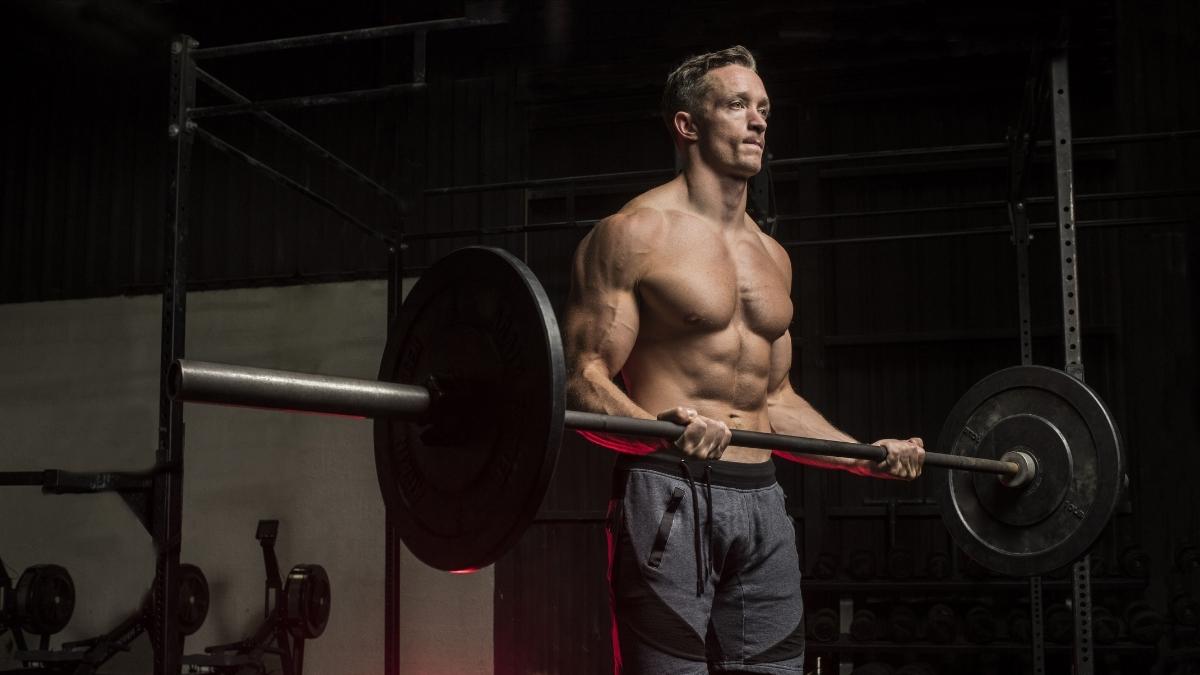
If you’re into weightlifting, chances are you want to have the physique to show for it. And for many gym enthusiasts, having well-defined arms that stretch the seams of your sleeves is a must. Big arms not only look impressive but also indicate your dedication to pumping iron. Beyond aesthetics, strong and muscular arms are essential for improving your bench press, overhead press, and rowing abilities; they’re not just the end goal but a means to achieving greater strength.
While many people believe that focusing on close-grip bench presses and standing curls is sufficient for targeting the smaller arm muscles, there is a science behind arm development. To truly build bigger arms, you need to grasp four key principles.
Arm Training Principles
- Muscle Mechanics: Understanding how your muscles move your joints is crucial. To effectively develop your biceps and triceps, you must select exercises based on their movement patterns.
- Training Volume: The amount of work you do (total reps) directly impacts muscle growth. Increasing training volume leads to more muscle growth, as long as you don’t exceed your body’s recovery capacity.
- Progression: A recommended progression model is double progression, where you increase weight only when you reach the upper limit of a specific rep range across all sets.
- Training Frequency: Research suggests that training arms twice a week is more effective for muscle growth compared to once a week. Training frequency of three times or more may or may not yield additional benefits. Since biceps and triceps are smaller muscle groups, they recover faster, allowing for more frequent training sessions. Some individuals train their arms three times a week, especially if they’re performing high volume (15 to 20 sets) per session. In such cases, splitting the sets into two to three separate sessions may be beneficial.
Muscle Mechanics
Before delving into effective arm training, it’s essential to understand the biomechanics of the arms. Let’s quickly review their basic anatomy.
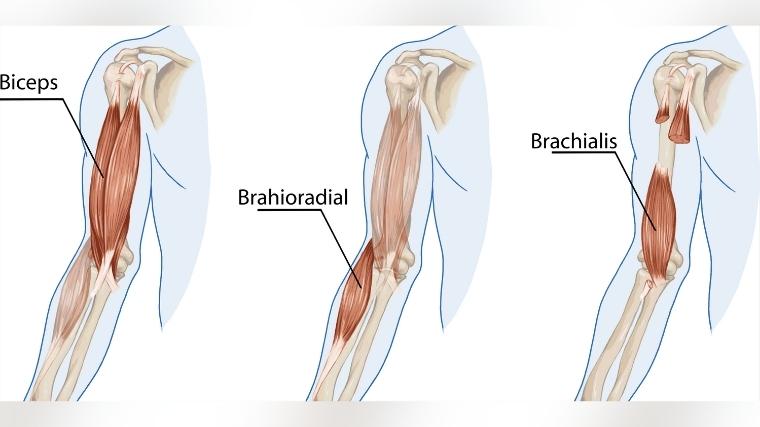
The Biceps
The upper arm comprises three muscles in the anterior compartment, but we’ll focus on two main muscles:
- Biceps brachii
- Brachialis
- Coracobrachialis
Biceps Brachii
The biceps consist of two heads: a long head (outer) and a short head (inner). Both heads originate from the scapula and insert on the forearm’s radius bone. The biceps play a role in flexing both the elbow and the shoulder.
Brachialis
The brachialis, a strong elbow flexor, originates from the humerus and inserts on the forearm’s ulna. Unlike the biceps, the brachialis is not involved in shoulder movement and solely flexes the elbow.
The Triceps
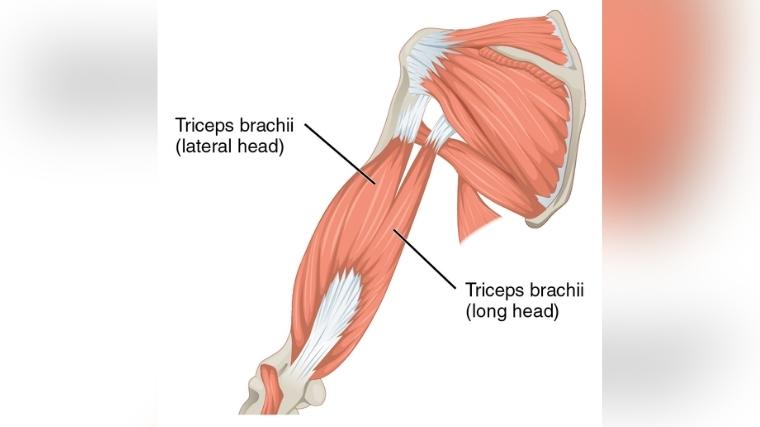
The triceps brachii is the primary muscle in the posterior arm compartment, consisting of three heads:
- Long head
- Medial head
- Lateral head
The triceps’ main function is elbow extension. All three heads insert on the forearm’s ulna bone, with origins varying on the upper arm’s humerus bone. Each head plays a role in different arm poses and movements.
Additional Considerations
While back and chest exercises can engage the biceps and triceps to some extent, relying solely on pulling and pressing movements may not fully maximize arm development. Studies show that pull-ups, rows, and presses activate the arm muscles, but direct arm exercises are still crucial for comprehensive growth. It’s important to balance your training regimen to ensure adequate stimulation for all muscle groups. If you’re already training back intensely twice a week, additional biceps workouts may not be necessary.
For optimal arm development, focus on moderate (8-12) and high (12-20) rep ranges to allow for adequate recovery and avoid redundancy. Since the triceps are also involved in pressing movements, it’s advisable to include exercises targeting different ranges of motion in your training routine.
The Missing Link
When it comes to arm training, exercise variety is key. Simply performing basic curls and extensions may not fully engage the muscles throughout their entire range of motion. To effectively target your arm muscles, you need to challenge them at different points:
- Mid-range: barbell curl, close-grip bench press
- Lengthened (stretched position): incline dumbbell curl, French press
- Shortened (contracted position): high-cable curl, cable pushdown
While lifting with a full range of motion is beneficial, it’s essential to select exercises that target each range effectively. The goal of arm training is not just to complete movements but to stimulate the muscles across the entire range of motion.
Putting it all Together
Now that you understand the fundamentals of arm training, let’s focus on a structured approach to building bigger arms. The following workout plan emphasizes targeting different ranges of motion to ensure comprehensive muscle stimulation.
Training Explained
The workout routine involves selecting primary exercises for biceps and triceps that emphasize either the lengthened or shortened ranges. These primary exercises are performed for heavier sets of six to eight reps with specific tempos.
Subsequently, a triset circuit consisting of movements targeting mid, lengthened, and shortened ranges is incorporated to further challenge the arms. This structured approach aims to distribute the workload evenly across all ranges of motion for optimal arm development.
| Exercise Sequence | Sets & Reps | Tempo | Rest | Target Range |
|---|---|---|---|---|
| A1) EZ-Bar French Press | 4 x 6-8 | 3010 | 60 seconds | Lengthened |
| A2) Incline DB Curl | 4 x 6-8 | 3010 | 60-90 seconds | Lengthened |
| B1) Triceps Pushdown | 2 x 10-12 | 2011 | 15 seconds | Shortened |
| B2) DB Skull Crusher | 2 x 12-14 | 2010 | 15 seconds | Mid-Range |
| B3) Cable Overhead Rope Extension | 2 x 15 | 2110 | 60 seconds | Lengthened |
| C1) DB Spider Curl | 2 x 10-12 | 2011 | 15 seconds | Shortened |
| C2) Standing EZ-Bar Curl | 2 x 12-14 | 2010 | 15 seconds | Mid-Range |
| C3) DB Preacher Curl | 2 x 15 | 2110 | 60 seconds | Lengthened |
Focus on tempo and range of motion during each exercise, ensuring your arms are challenged throughout. While you can perform this routine three times a week, prioritize quality over quantity initially. After six weeks of consistent training, you can consider increasing the frequency to three times a week for continued progress.
For progression, alternate between focusing on lengthened and shortened ranges in both primary and triset exercises. This variation helps prevent plateaus and ensures balanced arm development over time.
| Exercise Sequence | Sets & Reps | Tempo | Rest | Target Range |
|---|---|---|---|---|
| A1) Triceps Push Down | 4 x 6-8 | 3010 | 60 seconds | Shortened |
| A2) Ez-Bar Spider Curl | 4 x 6-8 | 3010 | 60-90 seconds | Shortened |
| B1) Cable Overhead Triceps Extension | 2 x 10-12 | 2110 | 15 seconds | Lengthened |
| B2) DB Skull Crusher | 2 x 12-14 | 2010 | 15 seconds | Mid-Range |
| B3) Single Arm Rope Triceps Extension | 2 x 15 | 2011 | 60 seconds | Shortened |
| C1) DB Incline Curl | 2 x 10-12 | 2110 | 15 seconds | Lengthened |
| C2) Standing EZ-Bar Curl | 2 x 12-14 | 2010 | 15 seconds | Mid-Range |
| C3) High Cable Curl | 2 x 15 | 2011 | 60 seconds | Shortened |
Nutritional Considerations
To support muscle growth, maintaining a caloric surplus is essential. Without sufficient calories, muscle mass gains will be limited. Consider the following nutritional recommendations:
- Consume 5-10% more calories than your maintenance level (Caloric Surplus).
- Eat four to five meals/snacks daily, ensuring adequate protein intake throughout the day.
- Focus on a macronutrient distribution of 35% protein, 35% carbs, and 30% fats to support muscle growth.
- While supplements can be beneficial, a basic regimen of multivitamins, fish oil, and probiotics is usually sufficient.
References
- Schoenfeld BJ, Ogborn D, Krieger JW. Effects of Resistance Training Frequency on Measures of Muscle Hypertrophy: A Systematic Review and Meta-Analysis. Sports Med. 2016;46(11):1689-1697. doi:10.1007/s40279-016-0543-8.
- Youdas JW, Amundson CL, Cicero KS, Hahn JJ, Harezlak DT, Hollman JH. Surface electromyographic activation patterns and elbow joint motion during a pull-up, chin-up, or perfect-pullup rotational exercise. J strength Cond Res. 2010;24(12):3404-3414. doi:10.1519/ JSC.0b013e3181f1598c.
- Snarr RL, Esco MR. Comparison of Electromyographic Activity When Performing an Inverted Row With and Without a Suspension Device. J Exerc Physiol. 2013;16(6):12-22. http://faculty.css.edu/tboone2/asep/Russell.pdf.
- Barnett C, Kippers V, Turner P. Effects of variations of the bench press exercise on the EMG Activity of 5 Shoulder Muscles. 1995:222-227.
Featured Image: Paul Aiken/Shutterstock