
During the transition from night to morning on Wednesday, August 12, four extraordinary celestial phenomena will take place within a span of approximately 24 hours. From the calmness of the new moon to a procession of planets, the dazzling streaks of the Perseid meteor shower, and the striking dimming of the Sun, the Universe serves as a reminder of the cycles and rhythms that have captivated humanity for millennia.
The timing of these events presents an opportunity to contemplate our connection with Nature. We are not separate from the natural world; we are an integral part of it. The rhythms of the Universe, Nature, Earth, seasons, light, darkness, activity, and rest offer a broader context for understanding our own existence.
Planetary Parade
Just before sunrise on August 12, six planets—Jupiter, Mercury, Mars, Uranus, Saturn, and Neptune—will appear to span across the sky in what resembles a planetary parade. While the planets are not aligned in a straight line physically, their positions create the illusion of a sweeping arc when observed from Earth.
This alignment of celestial bodies serves as a reminder that we are encompassed by an ever-changing network of energies. Each planet follows its unique path, yet together they form a pattern that is visible and felt from Earth. In a similar manner, the Five Elements are not isolated entities. They continuously interact with and influence one another.
New Moon & Total Solar Eclipse
Following the planetary parade, the skies offer another spectacle—a new moon. This particular new moon holds significance as it coincides with a total solar eclipse, resulting in a brief period of complete darkness as the moon moves directly between Earth and the sun.
The moon’s orbit around Earth is slightly tilted in relation to Earth’s orbit around the sun. Consequently, during most lunar cycles, the moon passes either above or below the Sun from our viewpoint on Earth. However, on August 12, the orbits align with remarkable precision, causing the moon to align directly in front of the sun. A total solar eclipse will be visible from parts of Europe and the Arctic, with North America witnessing a partial solar eclipse.
This same sense of stillness and renewal is experienced annually as Winter transitions into Spring. Now, as we enter Late Summer, the new moon and total lunar eclipse prompt us to turn inward and release what is no longer necessary. The eclipse also prompts us to recognize the interplay of Yin/Yang in our daily lives. Even when the sun is obscured by the moon, it remains present. Light persists even during dark moments when it is not visible.
Perseid Meteor Shower
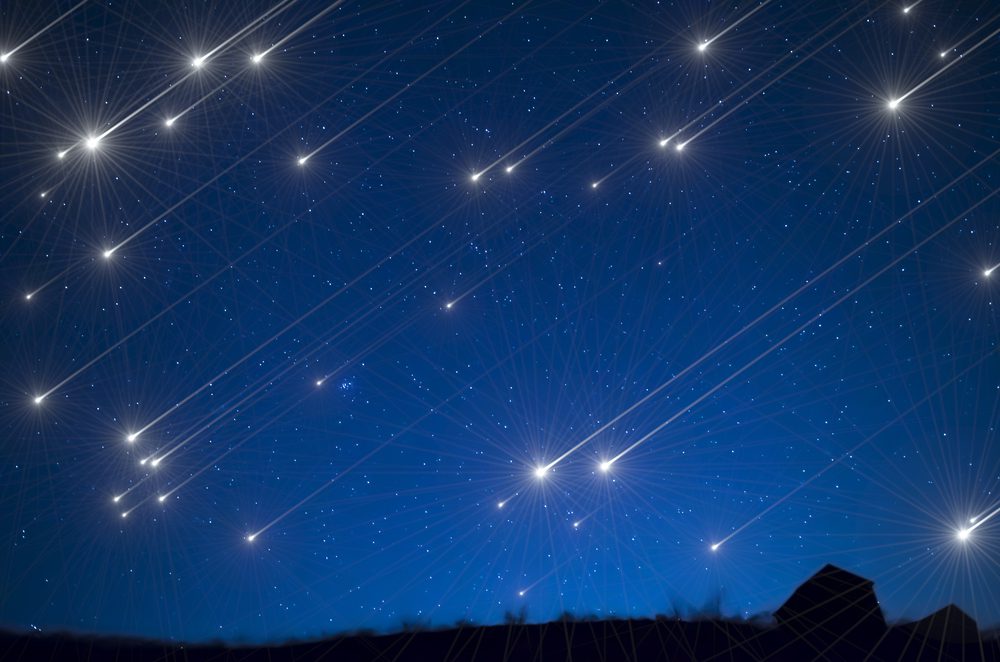
Subsequently, against the backdrop of a pitch-black sky a few hours post-eclipse, the Perseid meteor shower will offer a spectacular display. Observers can anticipate witnessing up to 100 shooting stars per hour on the night of August 12 and into the early hours of August 13.
The Perseids are the result of Earth passing through debris left behind by Comet Swift-Tuttle. Minute particles entering Earth’s atmosphere burn brightly, creating the streaks of light commonly referred to as shooting stars.
For optimal viewing of the Perseids, seek out a location with minimal light pollution and gaze directly upwards. All meteors originate from a single point in the Perseus constellation, known as the radiant. Locate Perseus, visible in the north to northeastern sky, and trace the tails of the meteors.
Join Us
On August 12, perhaps the most meaningful action we can take is to step outside, look skyward, and acknowledge our participation in something grander than ourselves.
With a new moon initiating the week, the moon will be only 13% illuminated on August 11, providing an ideal setting for meteor observation. Find a spot with minimal light pollution and relax as you observe. Join us in a standing meditation as we embrace The Dragon Stands Between Heaven and Earth during this energetic offering from the heavens.
Learn more about connecting with celestial energy here.