

Air bikes have come a long way from the old, creaky machines of the past. Modern air bikes are built sturdy and robust, with larger fans, heavier components, and electronic performance monitors. These machines are designed to withstand intense workouts and deliver a powerful performance.

The Assault Bike® is just one example of the modern fan-resistance, full-body stationary bikes, also known as “air bikes.” Other similar machines include the Echo Bike, Airdyne Pro, and various models. The term “Assault bike” has become a universal way to refer to all brands of air bikes, often used interchangeably with “air bike.”
Air bikes are efficient at working multiple muscle groups in the arms and legs simultaneously without breaks. This makes them ideal for conditioning, weight loss, and training all major metabolic energy pathways.
If you have access to an air bike, try out the challenging workouts below.
Best Air Bike Workouts
Best Air Bike Workout for Conditioning
Air bikes are considered more strength-based compared to spin bikes due to their formidable and non-adjustable resistance. While spin bike riders pedal at 70 to 110 revolutions per minute, air bike riders typically reach 40 to 80 revolutions per minute. The resistance on an air bike increases as you ride harder and faster, making it a preferred conditioning method for athletes with strength backgrounds.
Air bikes are also effective for training anaerobic capacity, which involves short-term, high-intensity endurance. Pushing hard on an air bike can engage anaerobic glycolysis, providing energy when oxygen delivery to muscles is insufficient.
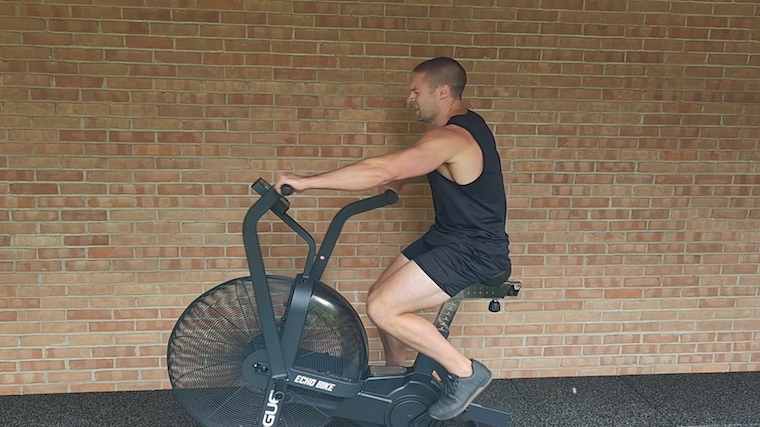
Training on an air bike can lead to high levels of lactate production, which is associated with the physical discomfort of anaerobic training. This discomfort, however, contributes to improved conditioning and fitness.
Modified Sprint Time-Trial Interval Training
Air bike workouts are designed to promote multi-system adaptations that improve health and overall performance. An effective conditioning workout should target all major energy systems and enhance overall work capacity.
The following air bike workout, inspired by a Danish protocol, involves intervals of varying intensity to challenge different energy pathways. Elite athletes in the original study saw significant fitness improvements, but the protocol has been modified for the average individual.
Gradually increase the intensity of your workouts by adding one five-minute interval each month. Aim to repeat this workout once or twice per week to see improvements in your conditioning.
- How to Do it: Alternate between high-intensity intervals using both arms and legs and recovery periods using only your legs. Warm up thoroughly, then perform sets of moderate-paced intervals followed by shorter, all-out sprints.
- Sets and Reps: Perform three sets of five-minute intervals followed by five sets of 15-second sprints.
- Rest time: Take a two-minute rest between each five-minute interval and a 45-second rest between each 15-second sprint.
Best Air Bike Workout for Fat Loss
Air bikes are an effective form of cardio for fat loss due to their ability to distribute training stress across both the upper and lower body. These bikes primarily involve concentric contractions, reducing the likelihood of post-workout soreness.
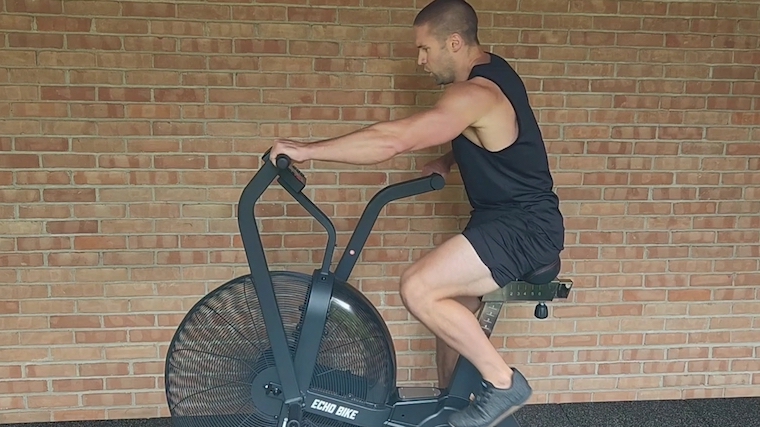
Concentric contractions are more energy-demanding and can lead to greater energy expenditure during workouts. Additionally, these contractions are less likely to cause muscle soreness compared to eccentric-heavy forms of cardio.
Zone 2 Fat-Burning Workout
For a low-impact, total-body workout that promotes fat burning without causing excessive soreness, try Zone 2 cardio on an air bike. This aerobic exercise targets 60 to 70% of your maximum heart rate, promoting the breakdown of fats in the presence of oxygen.
Aerobic training on an air bike helps improve body composition, heart health, and recovery between resistance training sets by enhancing muscle vascularization and mitochondrial density over time.

Break down your Zone 2 workout into segments to stay motivated and monitor progress. This fat loss workout consists of five segments with descending calorie targets to challenge and improve your endurance.
Repeat this workout three to five times per week as part of your fat loss plan, ideally after resistance training or with at least six hours of separation to optimize recovery and performance.
- How to Do it: Pedal at different intensities to burn a specific number of calories in each segment, aiming for faster completion times with each segment. Maintain Zone 2 intensity throughout the workout for optimal fat-burning benefits.
- Sets and Reps: Complete five calorie-burning segments with decreasing targets.
- Rest time: Take a 30-second rest after reaching each calorie target before continuing to the next segment.
Best Air Bike Workout Finisher
A workout finisher is a short metabolic conditioning session added to the end of your primary workout to maximize results. By training with low levels of muscle glycogen, you can stimulate energy system adaptations and improve metabolic efficiency.
Sprint Interval Training
Try this sprint interval training finisher on the air bike to boost your metabolism and complete your workout on a high note. This workout involves short, high-intensity intervals with incomplete recovery between bouts.
By performing intervals with incomplete recovery, you engage all three major energy pathways, leading to comprehensive energy system training. Incorporate this workout at the end of one resistance training session per week to enhance your metabolic conditioning.
- How to Do it: After a brief warm-up, pedal with maximum effort for 20 seconds every minute on the minute (EMOM) for a total of five minutes. Finish with two minutes of easy pedaling to cool down.
- Sets and Reps: Complete intervals every minute on the minute for a total of five minutes.
- Rest time: During the EMOM approach, rest actively or passively between intervals to maintain intensity.
How to Warm-Up for Air Bike Workouts
A proper warm-up is essential to prepare your body for exercise and optimize performance. A good warm-up increases body temperature, enhances blood flow to muscles, and improves joint mobility.
Try the following warm-up routine before your next air bike workout to ensure you’re physically and mentally ready for the session.
Air Bike Workout Warm-Up
- Easy ride: Start with three minutes of light pedaling to gradually increase your heart rate.
- Trunk rotations: While seated, rotate your trunk and reach forward with alternating arms to loosen up your upper body. Perform 20 total repetitions.
- Legs-only ride: Pedal using only your legs for one minute at an easy pace to engage your lower body muscles.
- Arms-only ride: Focus on arm movements only for one minute to activate your upper body muscles.
- Triple ramp-up: Pedal with both arms and legs for short intervals at increasing intensities to prepare your body for the workout ahead.
The Most Effective Cardio Machine?
Air bikes offer a versatile and challenging workout experience. Whether you prefer high-intensity interval training or steady-state cardio, air bike workouts are effective for metabolic conditioning and fat loss. These workouts can stand alone or complement traditional exercise routines to enhance overall fitness and performance.
Keep in mind that air bike workouts can be intense, so approach them with caution and listen to your body.
References
- Schlegel, P., Křehký, A., Hiblbauer, J., & Faltys, V. (2022). Air biking as a new way for stress testing. Movement & Sport Sciences-Science & Motricité. Published online ahead of print. doi.org/10.1051/sm/2022001.
- Buchheit, M., & Laursen, P. B. (2013). High-intensity interval training, solutions to the programming puzzle. Sports Medicine, 43(5), 313-338.
- Schlegel, P., & Křehký, A. (2020). Anaerobic Fitness Testing in Crossfit. Acta Facultatis Educationis Physicae Universitatis Comenianae, 60(2), 217–228.
- Robergs, R. A., et al. (2018). Lactate, not lactic acid, is produced by cellular cytosolic energy catabolism. Physiology, 33(1), 10-12.
- Gejl, K. D., Andersson, E. P., Nielsen, J., Holmberg, H. C., & Ørtenblad, N. (2020). Effects of acute exercise and training on the sarcoplasmic reticulum Ca2+ release and uptake rates in highly trained endurance athletes. Frontiers in Physiology, 11, 810.
- Hotfiel, T., et al. (2018). Advances in delayed-onset muscle soreness (DOMS): Part I: Pathogenesis and diagnostics. Sportverletzung· Sportschaden, 32(04), 243-250.
- Bogdanis, G. C., Nevill, M. E., Boobis, L. H., & Lakomy, H. K. (1996). Contribution of phosphocreatine and aerobic metabolism to energy supply during repeated sprint exercise. Journal of Applied Physiology, 80(3), 876–884.
Featured Image: Boonkung / Shutterstock