

For those looking to enhance muscle definition and expedite progress towards sculpted abs, consider utilizing this specialized fat loss training system with three distinct phases that prioritize muscle retention. Many are seeking guidance on post-COVID lockdown fitness routines.
To achieve improved muscle definition and fast-track your journey to washboard abs, follow this three-phase training system tailored for fat loss. Inspired by Tom MacCormick’s insightful article on making gains post-lockdown, this guide is designed for men aiming to shed pandemic-induced weight gain.
With the reopening of gyms, there is a surge in individuals eager to regain fitness quickly.
This efficient training system progressively boosts energy expenditure session by session, leaving you drenched in sweat — completing the workout in under 45 minutes, provided you prime your body adequately before starting.
The primary objective is to increase energy expenditure over time, starting with optimizing energy utilization through mitochondria. By focusing on muscular endurance and strength, you can enhance mitochondrial density, leading to more effective fat loss and muscle development.1
Higher mitochondrial content in cells accelerates fat loss and muscle growth. Training of this nature enhances the presence of GLUT-4 transporters in trained muscles, boosting glucose transport capacity.2
This emphasis on mitochondria growth sets the foundation for the subsequent training phases.
As you progress through each phase, intensity and workload will increase in the primary exercises.
The Primary Goal
The core focus of any fat loss program is to escalate work volume (density) in each successive training phase.
This workout regimen, commonly used in the initial fat loss phase for new clients, is strategically designed to ramp up energy expenditure by manipulating various variables that support efficient energy production and fat utilization.
Key components of any fat loss program include:
- Elevating lifting intensity and quality
- Increasing training volume in each phase
- Enhancing workout density in each subsequent phase
Phase 1 – Weeks 1-4
The Lower/Upper Superset Method
Phase 1 – How It Operates
By alternating between lower and upper body movements, more work can be accomplished while allowing muscles to rest. This dynamic muscle engagement:
- Intensifies body engagement
- Elevates energy expenditure
- Results in higher calorie burn
While exercises like deadlifts, bench presses, and squats are beneficial, they are not mandatory. The initial phase primarily focuses on neuromuscular adaptation before significant muscle growth occurs.3
Choosing movement patterns that enable continuous progression is crucial, setting the stage for further advancements in subsequent phases.
If certain exercises like squats or deadlifts are uncomfortable, alternative movements can be substituted. Prioritize results by avoiding exercises that hinder progress.
Phase 1 – Instructions
Perform both workouts (A & B) twice weekly. Exercises in A and B are structured as supersets, while C comprises three finishing exercises. Complete the required sets of the A series before moving on to B and then C.
Adhere to designated rest periods between supersets, ensuring seamless transitions between exercises. Stay disciplined with rest intervals to optimize workout efficiency.
Phase 1 – Training Schedule, Weeks 1-4
- Monday – Workout A
- Tuesday – Workout B
- Wednesday – Active Recovery
- Thursday – Workout A
- Friday – Workout B
- Weekend – Active Recovery/Rest
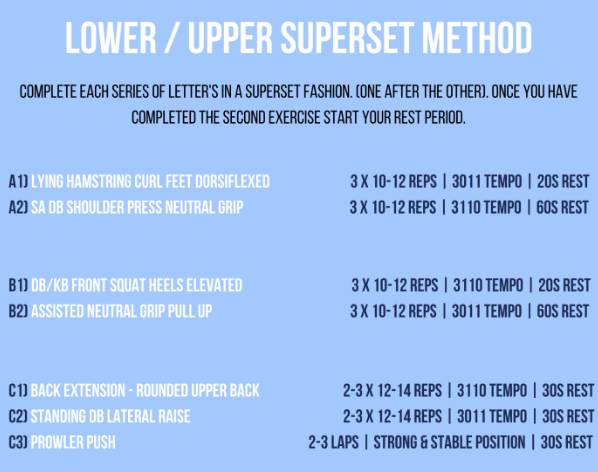
Phase 1 – Workout A
Complete each lettered series in a superset manner. Begin the rest period once the second exercise is done.
Phase 1 – Workout B
Execute each lettered series in a superset fashion. Initiate the rest period after completing the second exercise.
Phase 2 – Weeks 5-8
The Lower/Upper Superset Step Load Method
Phase 2 – Operational Approach
Building upon Phase 1, Phase 2 maintains the lower and upper body alternation but with a twist. Intensity and workload increase in the primary exercises, emphasizing high threshold motor unit activation.
The step load method involves reducing reps and increasing weight per set to engage high threshold motor units effectively. While lifting heavy is essential, avoid maxing out or reaching failure early in the workout.
As sets progress, ensure a 2 Reps in Reserve (RIR) approach for sets of eight, allowing for challenging yet controlled performance.
Retaining similar exercises from Phase 1, Phase 2 may introduce variations in angles or equipment usage.
Phase 2 – Instructions
Complete workouts A, B, and C in order. Each week, double up on one session and rotate accordingly.
Superset A and B exercises, reserving C for finishing moves. Progressively increase intensity throughout the A series.
Adhere to designated rest periods between supersets to maintain workout flow and effectiveness.
Phase 2 – Training Schedule, Weeks 5-8
Week 5
- Monday – Workout A
- Tuesday – Workout B
- Wednesday – Active Recovery
- Thursday – Workout C
- Friday – Workout A
- Weekend – Active Recovery/Rest
Week 6
- Monday – Workout B
- Tuesday – Workout C
- Wednesday – Active Recovery
- Thursday – Workout A
- Friday – Workout B
- Weekend – Active Recovery/Rest
Week 7
- Monday – Workout C
- Tuesday – Workout A
- Wednesday – Active Recovery
- Thursday – Workout B
- Friday – Workout C
- Weekend – Active Recovery/Rest
Week 8
- Monday – Workout A
- Tuesday – Workout B
- Wednesday – Active Recovery
- Thursday – Workout C
- Friday – Workout A
- Weekend – Active Recovery/Rest
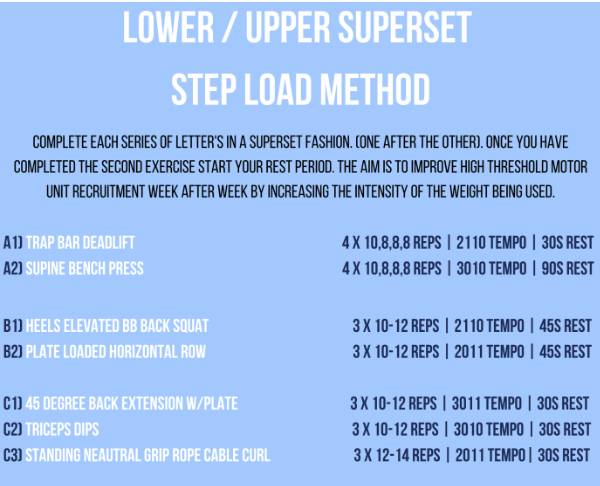
Phase 2 – Workout A
Execute each lettered series in a superset manner. Begin the rest period after completing the second exercise. Aim to enhance high threshold motor unit recruitment by progressively increasing weight.
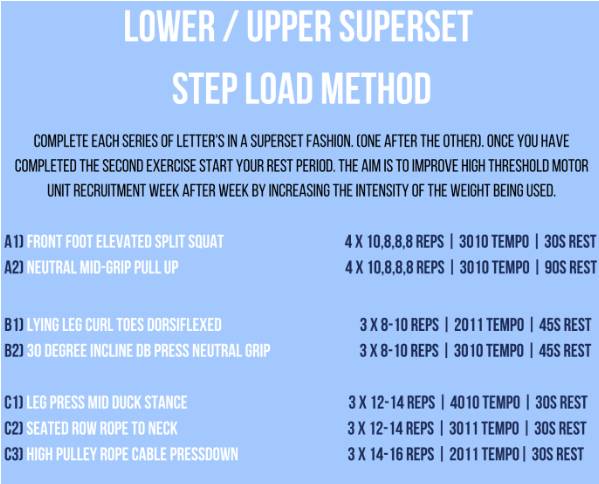
Phase 2 -Workout B
Complete each lettered series in a superset fashion. Initiate the rest period after finishing the second exercise. Continuously enhance high threshold motor unit recruitment by increasing weight.
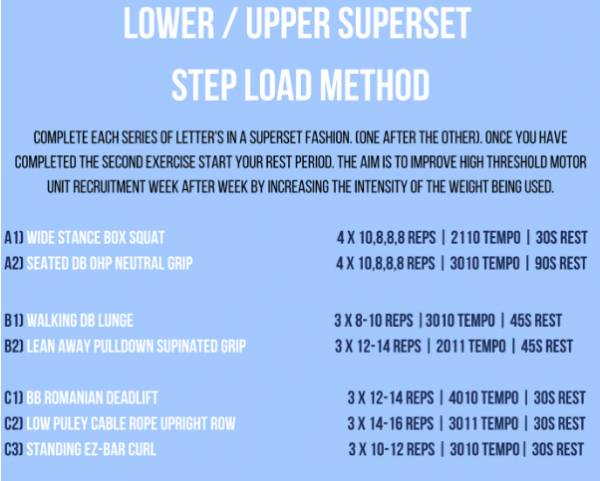
Phase 2 – Workout C
Execute each lettered series in a superset manner. Begin the rest period after completing the second exercise. Focus on enhancing high threshold motor unit recruitment by incrementally increasing weight.
Phase 3 – Weeks 9-12
6-12-25 Body Comp Method
Phase 3 – Operational Approach
This phase incorporates three exercises per muscle group arranged as a tri-set:
- Chest and Back
- Legs
- Shoulder and Arms
The focus of this phase is to maximize fat loss efficiency by elevating session density, promoting lactic acid buildup and cell expansion.
While achieving muscle pump is essential, maintaining the right rep-to-weight ratio is crucial to sustain workout intensity, especially during the first set of six reps.
Adhere to tempo guidelines for optimal training response:
- Maintain intensity
- Control tempo
- Sustain tension
- Push to fatigue
Tip: Avoid reducing working weights during this phase. If fatigued, use a brief rest-pause technique to complete the required reps without compromising intensity.
This phase allows for flexible workout selection, enabling focus on chest/back or shoulders/arms, alongside the standard rotations.
- Choose between chest/back enhancement or deltoid/arm refinement
- Complete all three prescribed workouts and add a fourth of your choice
Various scenarios outlining focus areas will be detailed for customization.
Phase 3 – Training Schedule, Weeks 9-12
Week 9
- Monday – Chest, Back
- Tuesday – Legs
- Wednesday – Active Recovery
- Thursday – Chest, Back
- Friday – Shoulders, Arms
- Weekend – Active Recovery/Rest
Week 10
- Monday– Legs
- Tuesday – Chest, Back
- Wednesday – Active Recovery
- Thursday – Legs
- Friday – Shoulders, Arms
- Weekend – Active Recovery/Rest
Week 11
- Monday – Chest, Back
- Tuesday – Shoulders, Arms
- Wednesday – Active Recovery
- Thursday – Legs
- Friday – Shoulders, Arms
- Weekend – Active Recovery/Rest
Week 12
- Monday – Chest, Back
- Tuesday – Legs
- Wednesday – Active Recovery
- Thursday – Chest, Back
- Friday – Shoulders, Arms
- Weekend – Active Recovery/Rest
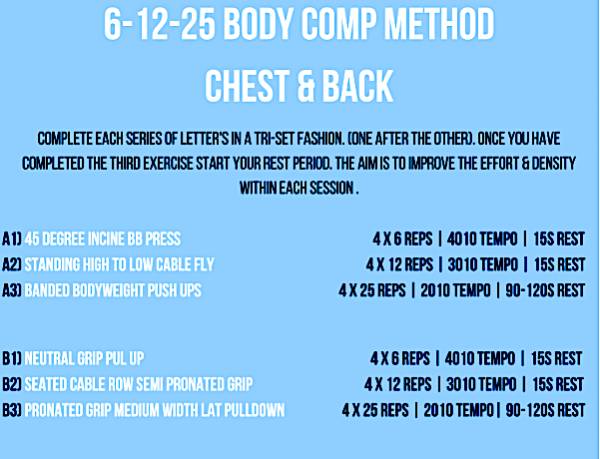
Phase 3 – Chest And Back
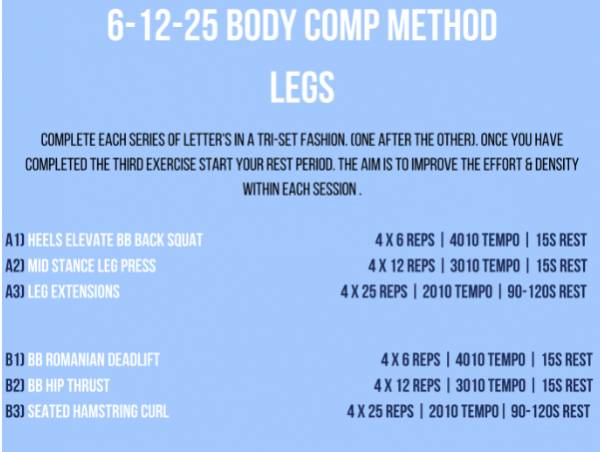
Phase 3 – Legs
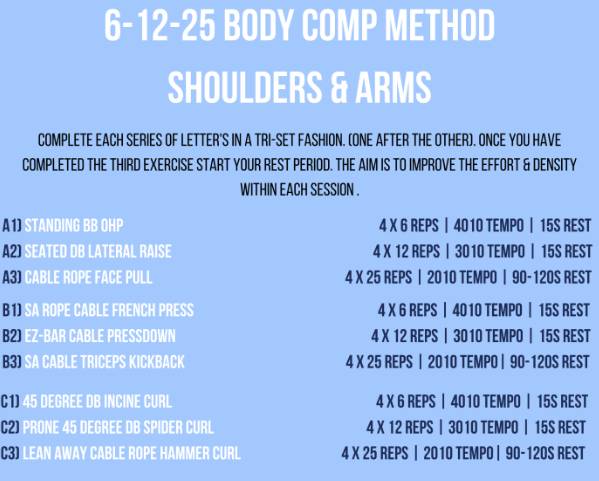
Phase 3 – Shoulders And Arms
Strategic Nutrition
Effective nutritional planning is crucial for maximizing the benefits of any training system. While this guide focuses on training specifics, an integrated diet plan can significantly enhance results.
For further insights on how nutrition impacts physique and performance, additional information on workout nutrition is provided. Otherwise, adhere to the following nutritional guidelines.
Phase 1 – Nutrition Targets, Weeks 1-4
Phase 1 advocates a low to moderate carbohydrate