

“I recently purchased a new BPA-free set of tupperware.”
My friend Anna’s statement took me by surprise.
Anna is a highly skilled legal professional known for her critical thinking and no-nonsense approach.
However, I noticed that Anna, who usually questions everything, seemed to be falling into some traps that were eluding her usual skepticism.
She had been aiming to shed about 15lbs for a while and reached out to me to express her frustration with feeling stuck in this goal.
During our conversation, she mentioned a new avenue she was exploring: the BPA-free tupperware set.
“Interesting. What made you focus on that?” I inquired.
“I’ve been reading about how microplastics in food containers can disrupt our hormones and contribute to weight gain,” she explained.
I raised an eyebrow.
To provide some context, this conversation followed Anna sharing her struggles with consistency at the gym, relying too heavily on takeout, and sacrificing sleep for endless scrolling on social media.
So I posed the question:
“Have you considered being more consistent with your workouts, or preparing more home-cooked meals during the week?”
Anna’s response was, “Yes, but I’ve tried that countless times. If it were that easy, it would have worked by now.”
We’ve all been there.
Choosing to overlook or delay essential yet challenging habit changes in favor of a specific, niche solution that promises to be a game-changer.
Spending hours researching the perfect workout instead of simply committing to the routine you already know.
Waiting for the right moment to feel inspired, motivated, or less busy.
Why do we do this?
Buying new gear or trendy supplements feels like progress.
Watching YouTube videos or reading articles about potential changes feels like taking action.
And postponing until the “perfect time” feels well, perfect.
However, true change only happens when we consistently take real action.
As humans, we have devised numerous sneaky ways to avoid the fundamental, unglamorous, and challenging actions required to drive real change.
In this article, we will delve into why individuals may distract themselves from taking meaningful action and how to address this.
You will discover:
- The most impactful health habits to focus on
- Three common obstacles hindering sustainable progress
- A 4-step approach to initiate positive, effective action
- Strategies to maintain consistency and achieve your goals
The essential tasks you know you should prioritize (but may be neglecting)
We are all familiar with the core, foundational health habits:
▶ Engaging in regular exercise, ideally 30 minutes daily, incorporating both aerobic and resistance training.
▶ Consuming predominantly nutritious, minimally processed foods. Striving for 80% of your diet to consist of whole or minimally processed foods is commendable. (Translation: You don’t need to strive for perfection; indulging in pizza occasionally is acceptable.)
▶ Including adequate protein to support muscle mass, appetite control, and body recomposition goals, if applicable. Aiming for approximately 1.2 to 2.2 grams of protein per kilogram of body weight (equivalent to about 4-6 palm-sized portions of lean protein daily for most individuals) is beneficial.
▶ Prioritizing quality sleep for seven to eight hours. While you may not always control the quality of your sleep, establishing a wind-down routine before bed and maintaining a consistent wake-up time can be helpful.
▶ Limiting or reducing excessive alcohol or drug consumption, including tobacco. It may not be enjoyable, but it’s beneficial in the long run.
While additional practices like fostering positive social connections, managing stress, and others are valuable, even meeting the above list is uncommon.
In fact, only six percent of Americans adhere to all five fundamental health behaviors outlined below:1
- Meeting physical activity guidelines
- Avoiding smoking
- Moderating alcohol intake (or abstaining)
- Getting at least seven hours of sleep
- Maintaining a “normal” BMI
Considering these statistics, nearly 94 percent of Americans are not engaging in these basics.
However, these foundational behaviors are instrumental in achieving various common objectives, whether it’s attaining a healthy weight, enhancing athletic performance, or leading a longer, healthier life.
So, why do we struggle to implement them?
Below are three common obstacles we observe among clients (and coaches), along with potential strategies to overcome them.
By the way, ambivalence is normal.
The conflicting emotions experienced when contemplating change have a name known as ambivalence.
Ambivalence illustrates the mixed feelings individuals encounter when considering adjustments like waking up earlier to ease morning stress or reducing screen time.
Feeling ambivalent about change—”I desire this, yet I also want that”—is natural and typical.
Similarly, experiencing resistance towards change—”I want this, but not that”—is also common.
These contradictory sentiments may appear puzzling or frustrating but are integral components of the transformation process.
Increased ambivalence and resistance often accompany significant changes, indicating the significance of these adjustments to individuals.
In essence, this emotional turmoil signifies a level of care and concern.
It signifies our investment in the change.
Obstacle #1: Ambitious Overload
Perhaps you’ve resolved to enhance your health. You declare that starting Monday, you’ll exercise for an hour daily, maintain a pristine diet at every meal, and ensure eight hours of sleep each night.
(Currently, you lack a consistent exercise routine, dislike vegetables, and frequently stay up past midnight.)
Let’s be honest: Attempting to alter multiple habits simultaneously is demanding.
And when was the last time an elaborate life overhaul plan actually succeeded?
Chances are, not often.
(And that’s okay.)
When we feel stuck or frustrated in our current situation, crafting a plan filled with lofty aspirations can offer temporary relief.
Our brains possess several cognitive biases that distort our perception of the future.
We tend to overestimate our future capacity for time, energy, focus, and motivation.2 3 4 5
There’s a comforting allure in burdening our future selves with grandiose plans. (After all, we won’t commence the plan until Monday.)
However, the issue lies in:
Complex, extensive plans often clash with our already hectic lives.
We underestimate the multitude of smaller tasks embedded within broader plans.
When we inevitably struggle to execute these ambitious goals, we blame ourselves, our traits, our “willpower,” or “discipline,” crafting a narrative of battling consistency or deeming this lifestyle unattainable.
Unfortunately, we then fulfill this prophecy.
Obstacle #2: Misconceptions about Effective Strategies
This obstacle stems from a prevalent belief:
“If achieving good health were merely contingent on moderate exercise, nutritious eating, and sufficient sleep, everyone would be healthy.”
Since most individuals are aware of the importance of consuming vegetables, getting adequate sleep, and staying physically active, right?
(We concur.)
Now, revisiting the earlier statistic:
Only 6 percent of Americans consistently adhere to the most basic health and fitness behaviors.
If we introduce slightly more advanced yet fundamental practices like consuming five servings of fruits and vegetables daily, optimizing protein intake, and effectively managing stress, that figure would considerably diminish.
Therefore, it’s crucial to acknowledge that these simple behaviors are effective because they are. The issue predominantly lies in the fact that most individuals (possibly close to 99 percent of us) do not consistently implement them simultaneously.
Moreover, it’s imperative to accept that these simple behaviors may seem mundane. This is partly why individuals are drawn to novel diets or “magical” supplements—they offer a more intriguing option to explore.
This inclination intensifies, especially if one has previously attempted the “eat more vegetables” approach, only to find the outcomes unsatisfactory.
Embracing something new and cutting-edge presents the prospect of a transformed outcome and individual.
And naturally, this prospect is tremendously enticing.
However, most hardcore, “industry-secret,” or “cutting-edge” methodologies and tools are respectively: unsustainable, inaccessible, ineffective, or unproven.
These endeavors demand your time, effort, and often finances without offering a substantial return on investment, all while diverting attention from strategies that actually yield results.
Obstacle #3: The Quest for Perfection
A prevalent misconception in the health and fitness realm is the necessity for “perfection” to maintain optimal health. Picture consuming solely organic salads and chia seeds, running marathons effortlessly, and waking up at 5 am daily for meditation and gratitude journaling.
However, perfection is not a prerequisite.
This realization could be either comforting or disappointing, contingent on one’s perspective.
On one hand, it’s reassuring to know that achieving exceptional health doesn’t mandate having everything “figured out”—even above-average health.
Conversely, many individuals pursue improved health under the assumption that their ideal or “perfect” self is attainable with the right plan or routine.
Yet, “perfect” health is an illusion.
Even individuals who epitomize exceptional health encounter health setbacks, such as illnesses, skin issues, digestive disturbances, need for corrective lenses, periods of low spirits, or simply a series of challenging days.
None of us are immune to life’s uncertainties, and acknowledging this vulnerability can feel unsettling.
It’s far more enticing to believe that consuming a particular algae supplement or adhering to a specific morning regimen can shield us from unpleasant human experiences.
Ironically, to attain your realistic “best self,” you must accommodate your “worst self” too. This refers to the individual who may prefer binge-watching TV over exercising, indulge in a party-sized bag of chips for dinner, or encounter various obstacles, distractions, and competing obligations that hinder consistent perfection.
Therefore, relinquishing the notion of an ideal self—the individual perpetually equipped with energy, resolve, and opportunities to make the optimal choice—can facilitate embracing one’s authentic desires and needs.
Below, we present a four-step approach to aid you in initiating effective and feasible action.
Step #1: Delve into the Why Before the How
Prior to embarking on a desired change, it’s advantageous to comprehend your underlying motivations.
Engage in introspection by exploring inquiries such as:
- What makes this change significant to you?
- How urgent or crucial is this change for you?
- What prevents you from continuing your current practices?
You can also utilize a motivational exploration exercise such as The 5 Whys.
By grasping the reasons driving your desire for change and discerning the consequences of not taking action, you’re more likely to sustain a profound, enduring motivation to persevere even amidst challenges.
Step #2: Prioritize the Most Effective Actions
While it’s tempting to juggle multiple tasks simultaneously, the key to sustainable change lies in:
- Identifying all requisite tasks, trade-offs, and commitments
- Highlighting essential actions for desired outcomes
- Determining the initial steps to take
Which actions are critical concerning your objective? Regardless of the goals, these are likely to encompass a movement regimen, nutritional practices, and recovery strategies.
If you seek guidance on selecting the most effective action tailored to your goal, refer to our Skills, Practices, and Daily Actions Cheat Sheet.
Here’s how to utilize it:
▶ Commence with the most intriguing domain you intend to enhance (e.g., “Nutrition” or “Stress”).
▶ Next, pinpoint the specific skill within that domain you wish to refine (e.g., “Eat intuitively”), along with the preferred practice under that skill (e.g., “Eat until satisfied”).
▶ Lastly, opt for a daily action from the examples listed under your chosen practice (e.g., “Monitor hunger and fullness levels before and after meals.”)
Upon selecting your action, customize it to suit your needs by proceeding to step 3 below.
Step #3: Ensure Feasibility Even on Challenging Days
“I challenge my clients to set a modest goal. If it’s so modest, then evidently, you can achieve it, right?” asserts Kate Solovieva, PN Super Coach and Director of Community Engagement.
Does this approach sound inspiring?
Possibly not.
Nevertheless, if you’ve been grappling with consistency, commencing with this approach is ideal.
Reflect on:
- What action can I undertake on my most challenging day, when everything seems to go awry? How much time, effort, or enthusiasm can I realistically muster?
Five minutes of walking? 10 push-ups? An additional serving of vegetables? Three deliberate deep breaths before each meal? No effort is too small; it just needs to be something.
Identifying your “floor” is paramount.
Subsequently, ponder:
- What action can I take on my best day, when I feel invincible, and circumstances align in my favor? How much time, effort, or enthusiasm can I realistically muster?
An hour of vigorous exercise at the gym? Two hours of meal prep to sustain you and your family for the next few days? A 45-minute guided meditation session?
This represents your “ceiling.”
By identifying your “floor” and “ceiling,” you establish a flexible spectrum of actions that can adapt to life’s unpredictable and fluctuating nature.
However, implementing this range necessitates a shift in mindset:
Your health habits are not binary but rather operate on a continuum.
During favorable, smooth-sailing moments, you can amplify your exercise, nutrition, and sleep practices—if desired. Achieve personal records at the gym, indulge in nutritious meals, and meditate extensively.
Conversely, when life throws curveballs, you need not abandon your efforts entirely.
Merely dial it down slightly.
The image below illustrates how this concept can be applied to exercise, although this approach is equally applicable to nutrition, sleep, stress management, or any other health-related aspect.
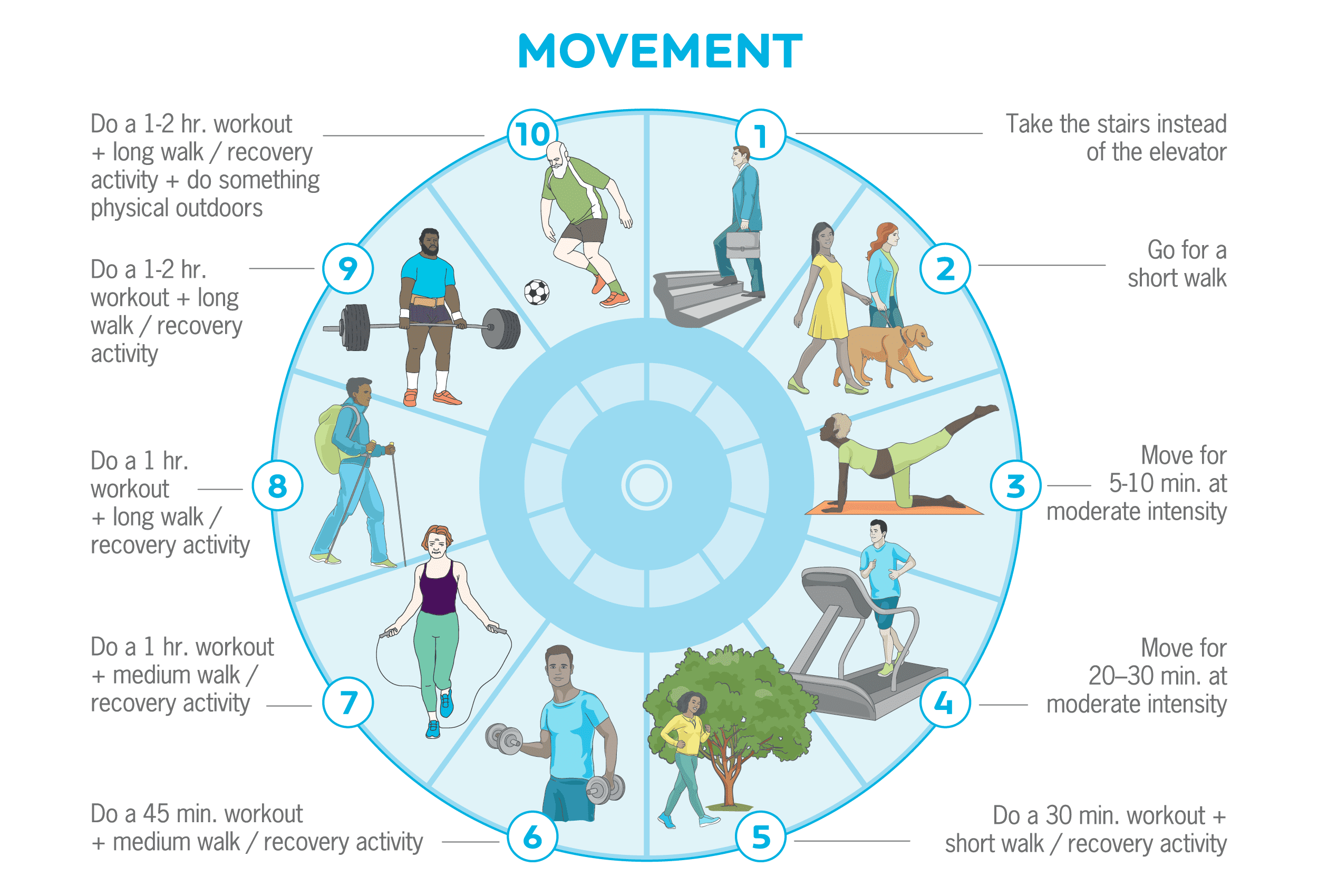
The crucial aspect is that even performing your “floor” or “level 1” action—be it for consecutive days—is still a step in the right direction.
You still earn a gold star.
Executing the bare minimum is not a failure.
It is a success within the realm of real