
Time surely flies by quickly. It feels like just yesterday when you would roll your eyes at the elders talking about their youthful days without aches and pains, full of energy and not worrying about exercise or diet. The concept of neglected health used to be distant, but here we are today: achy joints, cranky back, high blood pressure, and expanding waistline.
Don’t aim to be a model or pretend to be in your 20s or 30s. The goal is to move better, feel better, and maybe even look better. Whether it’s for yourself or to support a friend or parent in a similar situation, remember that most online workouts are too intense for beginners.
Regardless of your reason for reading, the question remains: where should we begin? You’re ready to get off the couch and take action. But how?
The Beginner’s Plan
This plan is designed for beginners dealing with aches, aging, and/or poor physical condition. It serves as a starting point for those recovering from injury or transitioning to a healthier lifestyle after neglecting their health. It’s a foundation, a beginning. If you’re seeking a more challenging program, consider exploring premium exercise plans like The Will and The Way or Push, Pull and Thrive.
First things first: regardless of your current state and limitations, exercise is essential for everyone. Every little bit counts. So, where do we start? Working out may seem complex with numerous articles available, but it’s actually quite simple.
You just need to grasp a few key principles:
- Always prioritize proper form in your movements. It’s better to move correctly than risk injury by moving incorrectly. Focus on controlling the tempo of each exercise, emphasizing the concentric, isometric, and eccentric phases. Slowing down the tempo enhances control and stability, even with light weights.
- All training involves progression and regression. This is known as the Goldilocks principle. If an exercise is too challenging, your form suffers. Harder isn’t always better. If you feel overwhelmed, dial it back. Conversely, if an exercise is too easy, it’s not effective. Find the intensity level that’s just right for you.
That’s all you need to know to follow a good exercise plan. Focus on executing the movements correctly and adjust the intensity based on your comfort level. I’ll take care of the exercise selection, sets, reps, and more. You don’t need any fancy equipment to get started. So, let’s get moving!
The Plan to Get Off the Couch: Weeks 1 and 2
Especially in the beginning, it’s better to do simple, low-intensity exercises daily than to push yourself hard a few times a week. I recommend consistent, brief workouts lasting 20 minutes or less. Incorporate activities like walking and cleaning into your daily routine for added movement.
Week 1: Choose one of these circuits to do daily in week one. You can stick to the same circuit or mix them up. Each circuit should take around 10 minutes. Aim to complete the circuit 5 days out of 7, using one rest day for a leisurely walk.
Week 2: Repeat the same routine as week one, but on alternate days, try to do a second round of the circuit if you feel up to it. Aim for at least two rounds throughout the week.
Here’s a suggested schedule:
| Monday | 2 rounds of circuit 1 |
|---|---|
| Tuesday | 1 round of circuit 2 |
| Wednesday | 1 round of circuit 1 |
| Thursday | 2 rounds of circuit 2 |
| Friday | Walk |
| Saturday | 1 round of each circuit |
| Sunday | Rest |
Circuit 1
Follow these exercises in sequence, focusing on controlled, deliberate movements:
- Neck Nods – 5 repetitions up and down
- Neck Circles – 3 rotations to the right and 3 to the left
- Arm Circles – 5 forward and 5 backward
- Marching High Knees (right, then left leg) – 10 reps per leg
- Standing Leg Lifts (right, then left leg) – 10 lifts per leg
- Lying Y – 10 repetitions
- Lying T – 10 repetitions
- Lying W – 10 repetitions
- Push Up Position Plank (PUPP) or Normal Plank – Hold for 5 to 30 seconds
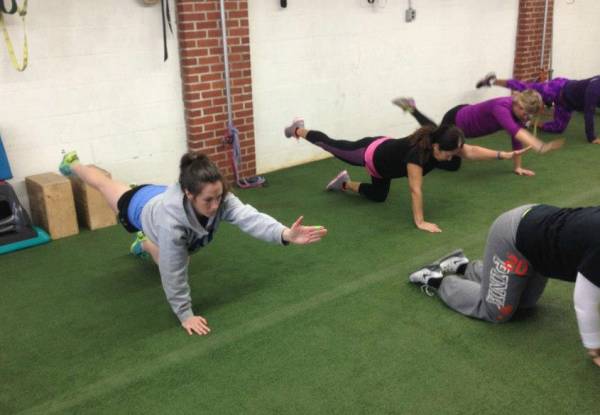
- Bird Dog – 5 repetitions per side
- Sit on the Floor and Stand Up – 10 times (reduce if too challenging)
- Glute Bridge Hold – Hold for 5 to 30 seconds
Circuit 2
Perform these exercises in order, focusing on controlled movements:
- 6-Point Neck Nods – 5 up and down
- 6-Point Rocking – 5 back and forth
- Quadraped Donkey Kick Backs – 5 per leg
- Push Up Position Plank (PUPP) or Normal Plank – Hold for 5 to 30 seconds
- Standing Upper Body Only Jacks – 15 repetitions
- Bent Over Y-Raise – 15 repetitions
- Straddle Stance Rotations – 5 per side
- Partial Wall Sit – Hold for 5 to 30 seconds
- Wall Push Ups – 10 repetitions
- Side Lying Leg Lifts – 10 per leg
- Superman – 5 repetitions
Moving Forward: Weeks 3 and 4
Begin each day with the daily warm-up routine.
Week 3: Alternate between these two workouts in week three. Aim for 5 days out of 7 and incorporate a walk on one of the rest days.
Week 4: Follow the same routine as week three, but on alternate days, try to complete a second round of the circuit if you feel comfortable. Aim for at least two rounds during the week.
Here’s a suggested schedule:
| Monday | 2 rounds of circuit 1 |
|---|---|
| Tuesday | 1 round of circuit 2 |
| Wednesday | 1 round of circuit 1 |
| Thursday | 2 rounds of circuit 2 |
| Friday | Walk |
| Saturday | 1 round of each circuit |
| Sunday | Rest |
Your Daily Warm-Up:
- Neck Nods – 5 up and down
- Neck Circles – 3 right and 3 left
- Arm Circles – 5 forward and 5 back
- Marching High Knees (right, then left leg) – 10 per leg
- Standing Leg Lifts (right, then left leg) – 10 per leg
- Lying Y – 10 repetitions
- Lying T – 10 repetitions
- Lying W – 10 repetitions
- Push Up Position Plank (PUPP) or Normal Plank – Hold for 5 to 30 seconds
- Bird Dog – 5 repetitions per side
- Sit on the Floor and Stand Up – 10 times
Iso Hold Circuit
Perform this routine after your warm-up.
Note: Lower into each position slowly and aim to hold for 5 to 15 seconds before safely pushing out. Avoid reaching muscle failure.
- Hands Offset Partial Squat
- PUPP
- Glute Bridge Right Leg
- Glute Bridge Left Leg
- Partial Split Squat Right Leg
- Partial Split Squat Left Leg
- Chair Hold Calf Raises
- Side Plank Right
- Side Plank Left
- Superman
Moving Circuit
Complete this routine following your warm-up.
These exercises involve more movement but maintain a focus on controlled, steady motion.
- Happy Baby – as desired
- Down Dog – Rocking back and forth as desired
- Frogger Hip Thruster – 10-20 steps
- Crawl or Bear Walk – 15-30 seconds
- Hands Offset Squats – 10 repetitions
- Chair Hold Calf Raises – 10 repetitions
- Lying Y-W Handcuff – 10 repetitions
- Shadow Boxing 1-2-1 Pattern – 5 repetitions
- Bird Dog – 5 repetitions per side
- On Back, Stand, On Belly, Stand – x10
Adjusting Exercise Intensity
You can always adjust the intensity of your workouts by moving along the intensity continuum. Listen to your body and explore different levels of intensity to find what works best for you.
To decrease intensity, consider:
- Reducing Resistance (using lighter weights)
- Slowing down your movements
- Decreasing Repetitions
- Lowering Density (less work time compared to rest)
- Engaging in Low-Intensity Exercises: jogging, rowing, biking, lightweight circuits, flows, jump roping, etc.
To increase intensity, consider:
- Adding Resistance (using heavier weights)
- Increasing Speed
- Adding Repetitions
- Increasing Density (more work time compared to rest)
- Engaging in High-Intensity Exercises: sprints, jumps, heavy resistance training, medium weight with short rest circuits, etc.
Keep in mind that reps may vary based on intensity level. For instance, in a heavy farmer’s walk (high-intensity), reps refer to the number of steps taken, while in an easy jog (low-intensity), reps may involve covering more distance. Adjust your intensity based on your body’s response and explore different options.