
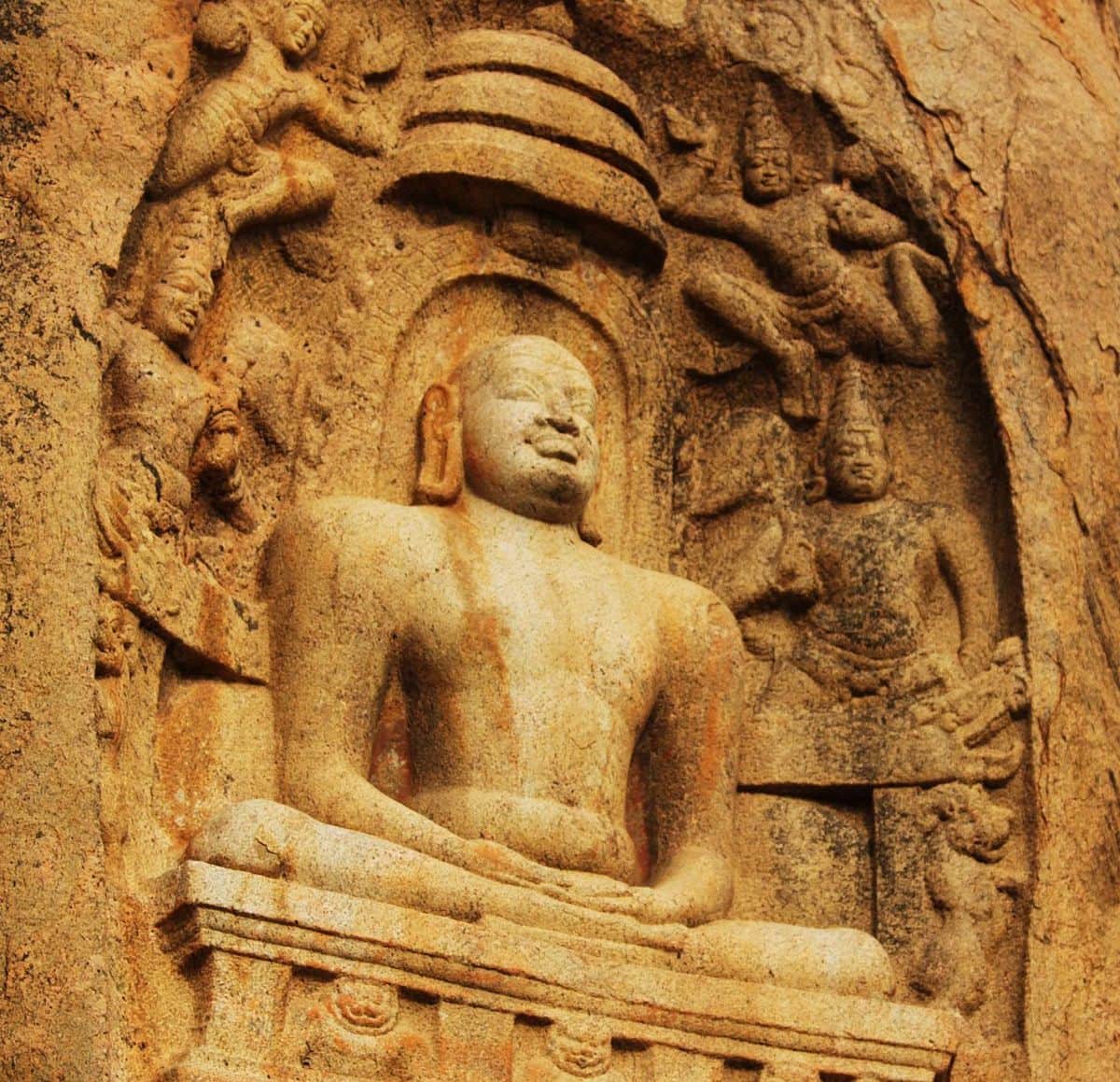
Meditation started to become really mainstream around the turn of the millennium—but few people are aware of how old and broad this art really is, and how it got developed in different parts of the world. In this short essay, I’ll attempt to give a general map of the history of meditation, and its many contemplative traditions.
The information in this article was collected from my years of study in different traditions. Other than that, it’s not easy to find this information laid out like this, as each tradition tends to focus only on its own history, and offers just one piece of the puzzle.
This essay presents an overview of the history of meditation in Buddhism, yoga, Christianity, and other traditions. Toward the end, you will also find information on the history of meditation in the West.
Understanding the bigger picture and origins of meditation will allow you to discover which tradition or which type of meditation you would like to explore.
At the end of this page you can download a free PDF of this article.
Finally, part of the material here was also published in my new book Practical Meditation, and is reproduced here with the permission of Dorling Kindersley Limited (DK).
If you are not familiar with the definition of meditation, please first read this article on what is meditation.
1. Cave Yogis and Vedic Sages
Where did meditation come from?
Meditation originated in India, a very long time ago. The oldest documented evidence of the practice of meditation are wall arts in the Indian subcontinent from approximately 5,000 to 3,500 BCE, showing people seated in meditative postures with half-closed eyes.
The oldest written mention of meditation is from 1,500 BCE in the Vedas. That is the time when the Vedas made it to paper, but it must be understood that the Vedas had been memorized and passed down as an oral tradition for centuries, long before they were finally written down. In fact, the Brihad Aranyaka Upanishad (f14th century BCE) lists nearly 70 generations of meditation gurus and students that had existed up to that point.
During this ancient time, meditation was a practice for religious people and wandering ascetics, who through it sought to transcend the limitations of human life, connect with universal forces (personified as deities), and union with the transcendental reality (called Brahman in the Vedas).
The Hindu tradition of meditation includes both the Yogis meditating in caves, as well as the Sages (rishis) of the Vedic culture. It is the oldest meditation tradition on Earth—still alive and thriving. It has hundreds of lineages and techniques.
Most likely the first meditation technique to be invented/discovered was either mantra meditation or gazing—although we can’t know for sure.
The modern Yoga movement, which emphasizes postures and breathing exercises, is an adaptation of just one of these hundreds of Yogic schools (the Hatha Yoga school). In general, Yoga is a wisdom tradition whose core is meditation and spiritual development—not a system of stretches and breathing practices.
2. The Buddha
In the 6th century BCE, Siddhartha Gautama abandoned his royal life as a prince and set out to attain Enlightenment. In this process, he learned meditation and philosophy from the best Yogis he could find in his region.
After a while, still dissatisfied with what he learned, he diverged from that tradition and created his own methodology. He achieved the Enlightenment he sought and became the Buddha. He then spent the next decades of his life teaching meditation and spiritual awakening to thousands of people.
Over the next several centuries, Buddhism spread all over Asia, and many different lineages were formed. Nowadays, the Buddhist styles of meditation (Vipassana, Samatha, Loving-Kindness and Walking Meditation) are perhaps the most widely practiced forms of meditation in the West.
3. Jainism, Taoism, Confucianism
In the same “golden century” as the Buddha, three other religions were born, all with their own approaches to meditation. They are:
- Jainism in India (founded by Mahavira)
- Taoism in China (founded by Lao Tze)
- Confucianism in China (founded by Confucius).
Jainism is a very ascetic tradition that places great emphasis on self-purification, self-discipline, contemplation, and non-violence. The Jain meditation techniques involve mantra repetition, gazing, breath awareness, visualizations, and self-inquiry.
Taoism emphasizes union with Tao, or cosmic life/nature. You can learn more about Taoistic meditation here, and check the chapters on Zuowang and Neiguan in my book for step-by-step practices from this tradition.
Confucianism focuses more on morality and community life. Meditation was developed in this tradition centuries later, with a focus on self-contemplation and self-improvement. It is called Jing Zuo.
These traditions are still alive today, although not as popular outside their home countries as Buddhism and Yoga are.
4. Greek Philosophers
The Greek philosophers, partially under the lively influence of sages and yogis of India, developed their own version of meditation. Such cultural influence was enhanced by Alexander the Great’s military exploits of India (327–325 BCE), which brought both cultures in touch.
In the words of the scholar George Feuerstein, in his excellent book The Psychology of Yoga:
“Plato and Aristotle, as well as the historian Herodotus, freely admitted the influence of the Orient upon Greek thought. (…) For the Greeks, the Indian sages exemplified the highest virtues of the philosophical life that they themselves sought. The Greeks admired the sages’ apparent immunity to pain and discomfort, as well as their disinterest in pleasure and what the Greeks saw as their contempt of death.”
Greek philosophers practiced navel-gazing (omphaloskepsis), as an aid to philosophical contemplation.
In the future, philosophers Philo of Alexandria and Plotinus also developed meditation techniques, particularly focusing on concentration. The influence of Eastern thought and contemplative traditions on the West diminished as Christianity began to dominate Europe for many centuries. It wasn’t until the 20th century that the dialogue between East and West started to flourish again.
Christian mystics created their own form of meditation, often centered around repeating a religious word or phrase and silently contemplating God. The Jesus Prayer, developed between the 10th and 14th centuries in Greece, is one example. It is believed that this group of Christians may have had interactions with Sufis and Indians, which could have influenced their meditation practices. Other forms of Christian meditation, such as those within the Eastern Christian sect, involve the repetition of a phrase and are older than the Jesus Prayer.
Zen Buddhism, founded by the monk Bodhidharma in the 8th century, is a popular school of Buddhism that emphasizes meditation. The practice of Zazen, a meditation technique of Japanese Zen, remains popular in the West. Some Zen lineages also focus on Koans as a form of meditation.
Sufism, the mystical branch of Islam, developed meditation practices incorporating breathing, mantra, and gazing. Their core practice revolves around connecting with God (Allah) and includes the iconic Sufi whirling, still observed in Turkey today.
Jewish meditation, rooted in the Kabbalistic tradition, involves deep contemplation of philosophical principles, names of God, symbols, prayers, and the Tree of Life.
In the modern Western world, Eastern philosophies like Buddhism began to be translated into European languages in the 1700s, sparking interest among intellectuals. Figures like Ralph Waldo Emerson and Henry David Thoreau, part of the Transcendentalist movement, admired Eastern philosophy and spirituality. The introduction of yoga and meditation to the United States in the early 20th century by Swami Vivekananda further fueled this interest.
The era of meditation and science saw the first scientific research on meditation in the 20th century, with pioneers like Swami Rama being studied by Western scientists for his abilities to control bodily processes voluntarily. This sparked further scientific interest in studying the effects of meditation on the body, leading to an increase in studies on meditation over the following decades.
Herbert Benson, a researcher at Harvard University in the early 1970s, delved into the effectiveness of meditation. Up until then, meditation was predominantly viewed as a religious practice and not commonly utilized for healthcare purposes. Benson’s work marked a turning point in this perception.
Meditation Today
In the present day, meditation has transitioned into mainstream acceptance and has been largely secularized. While spiritual meditation still persists, the secular approach to meditation, emphasizing its benefits for the body, mind, and overall wellness, has led to its growing popularity.
What’s the next step?
- Are you interested in detailed instructions to explore the techniques of various meditation traditions? Check out my book, Practical Meditation.
- Would you like to delve deeper into the philosophy of these traditions? Explore my recommended book list.
- Looking for guided meditations to accompany your practice of these techniques? Consider joining my Meditation Library membership.
History of Meditation PDF
Here is the PDF version of the post, as promised.
[If you are already subscribed to my mailing list, rest assured that only one instance of your email will be retained. No duplicate messages will be sent].
[Images attribution: Cover (wikimedia.org); Vedic rishis (baps.org); Buddha (buddhist-art.net); Sufi (javanemrooz.com); Thoreau quote (azquotes.com); Swami Rama on the lab (kansasmemory.org/); Lama on the lab (buddhistdoor.net); Meditation today (massagetherapyoga.com)]
Please rewrite the following sentence.