
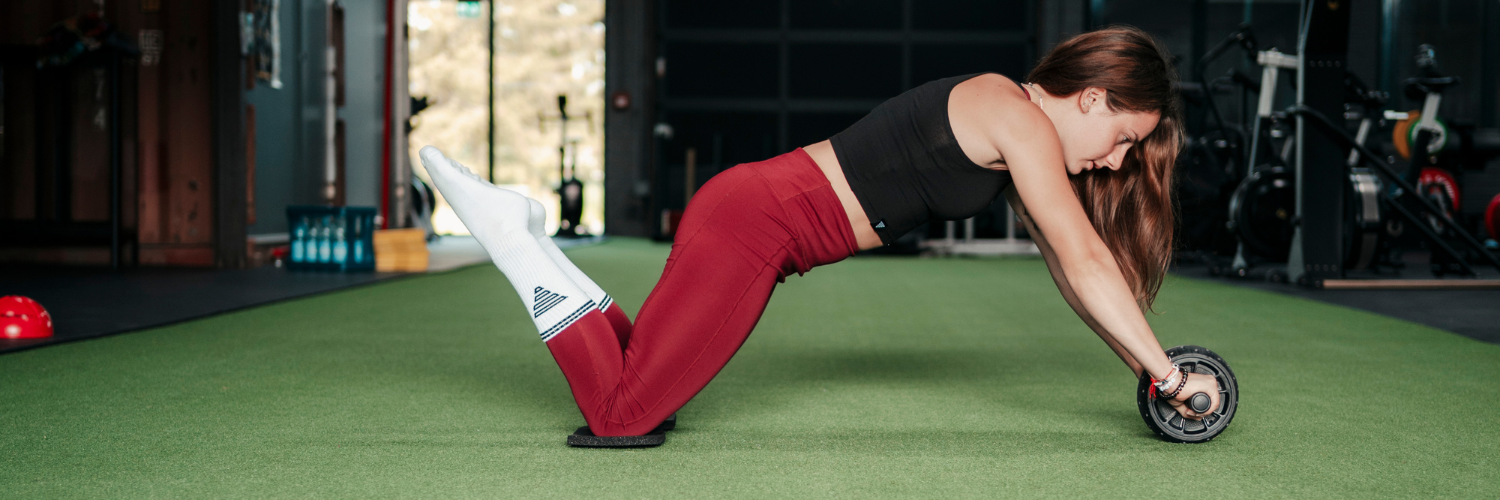
The Ab Wheel: Definition and How It Works
The Ab Wheel is a fitness accessory composed of a central wheel and two handles. It is typically performed kneeling or standing and consists of rolling the wheel forward while maintaining constant core tension, then returning to the starting position.
Unlike traditional abdominal exercises, using an ab wheel involves dynamic core training. The principle relies on a controlled imbalance: the further the wheel moves away from your body, the greater the tension placed on the abdominal muscles.
This mechanism makes the ab wheel particularly popular in fitness training, calisthenics, and athletic conditioning.
Which Muscles Are Actually Worked with the Ab Wheel?
Although it primarily targets the abdominal muscles, the ab wheel activates far more than just the “six-pack”.
When you properly use an ab wheel, the following muscles are involved:
-
-
Rectus abdominis, responsible for the visible six-pack appearance
-
-
-
Transverse abdominis, a deep muscle essential for core stability
-
-
-
Obliques, which help stabilize and control the movement
-
-
-
Shoulders, heavily engaged during the extension phase
-
-
-
Back muscles, especially the latissimus dorsi
-
-
-
Lower back muscles, which contribute to stabilization
-
-
-
Glutes, crucial for maintaining proper pelvic alignment
-
This global muscle activation makes the ab wheel a complete and functional exercise.

Why Include the Ab Wheel in Your Training Routine?
Adding the ab wheel to your workout routine offers many benefits.
First, it provides deep and effective abdominal strengthening, far superior to traditional crunches. The core stabilization work improves posture, stability, and force transfer to other exercises.
Additionally, the ab wheel helps you:
-
-
Improve core control and stability
-
-
-
Strengthen your abdominal belt
-
-
-
Develop stronger and more visible abs
-
-
-
Progress at any level thanks to scalable variations
-
It’s an ideal tool for anyone who wants to optimize their training without adding lots of equipment.
How to Properly Use the Ab Wheel: Technique and Correct Posture
Using the ab wheel with proper technique is essential to get the most out of the exercise while protecting your lower back. Controlled movement and strong core engagement are the key factors that make this exercise both safe and effective.
Starting Position
You can perform the exercise either on your knees or, if you are more advanced, from a standing position on your feet. Beginners should start on their knees to learn the correct technique and build the necessary core strength.
Kneel on a comfortable surface and firmly grip the handles of the ab wheel. If you’re using the GORNATION Ab Wheel, you can place the included knee pads under your knees for extra comfort and support during the exercise. Position the wheel on the floor in front of you and align your shoulders, hips, and knees so your body forms a straight line.
Before initiating the movement, actively engage your core and glutes. This tension stabilizes your body and prevents your lower back from arching during the rollout.
Execution
Take a deep breath and slowly roll the wheel forward in a controlled motion. Keep your arms almost straight and maintain a neutral spine while your body extends toward the floor. The movement should be smooth and controlled, with your core working to keep your body stable.
Once you reach your maximum controlled range, pull the wheel back toward your starting position by contracting your abdominal muscles. Avoid using momentum and keep your hips and lower back stable throughout the movement.
Perform the exercise slowly and with full control. A controlled execution not only reduces the risk of injury but also ensures that your core muscles are doing the work, making the ab wheel one of the most effective tools for building strong and stable abs.

Common Mistakes to Avoid with the Ab Wheel
Many mistakes can reduce the effectiveness of the exercise and increase the risk of injury.
The most common ones include:
-
-
Overarching the lower back
-
-
-
Rolling too far without control
-
-
-
Forgetting to engage the glutes
-
-
-
Holding your breath during the movement
-
-
-
Using momentum instead of abdominal contraction
-
Correcting these mistakes will quickly improve both safety and results.
How to Start Using the Ab Wheel Safely
For beginners, progression is the priority.
The ab wheel is an intense workout that relies on a strong core foundation.
Before starting, make sure to:
- Prepare your shoulders and core by warming up
- Practice static core exercises such as planks
- Begin with a limited range of motion
The key is not to extend too far, but to maintain proper form at all times.
If you need help with a suitable warm-up routine or guidance on structuring your warm-up, check out our YouTube video for a simple and effective warm-up before your workout.
Progressions and Variations for Beginners
To advance safely with the ab wheel, consider these variations:
- Partial kneeling roll-out
- Hold the bottom position as long as possible
- Assisted roll-out (using a resistance band)
- Focus on the negative part of the movement
These progressions help strengthen the abs without straining the lower back.
Frequency for Seeing Results
The ab wheel engages the core muscles intensely, so using it daily is unnecessary.
For visible progress, aim for 2 to 3 sessions per week, consisting of 3 to 5 sets of 6 to 12 controlled reps.
When incorporated wisely into your training regimen, the ab wheel can be a highly effective tool for long-term core strength and stability.
Could you please rewrite the following statement?