
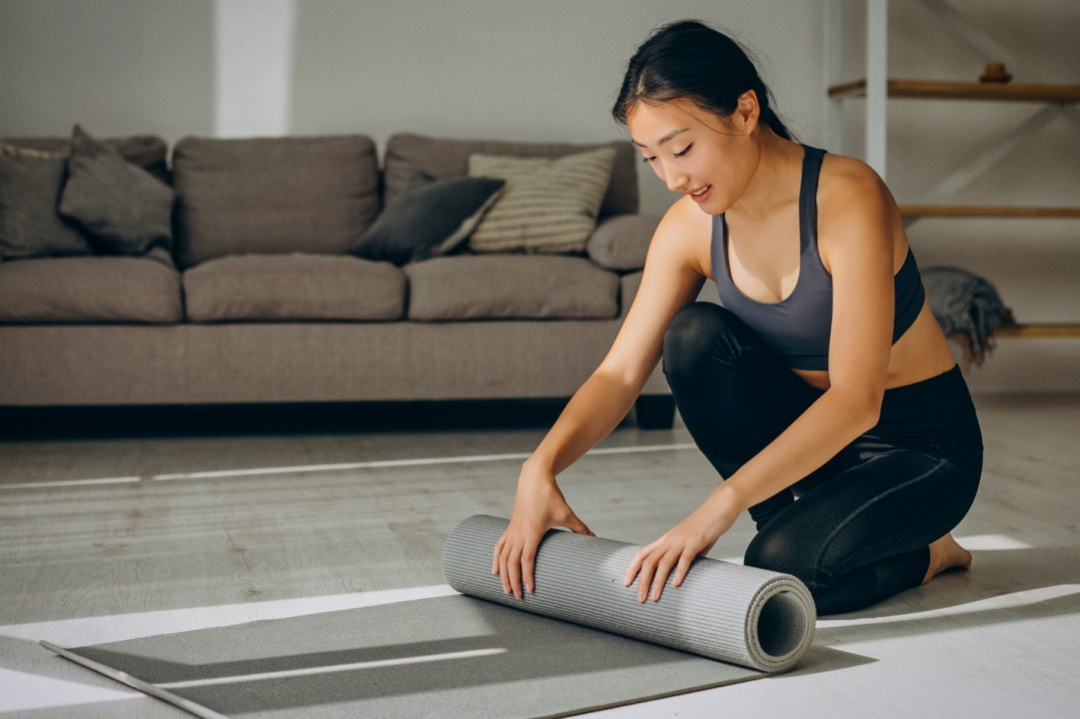
Establishing a home yoga routine can be a wonderful method to sustain and deepen your yoga practice. It is a convenient option for those who struggle to fit classes into their schedule or wish to practice more frequently without financial constraints. One of the advantages of a home-based practice is its adaptability. You have the freedom to start and end at any time, tailor it to suit your mood and physical requirements, and choose any style or volume of music that resonates with you at the moment.
What does a home yoga practice entail?
A home yoga practice involves integrating some form of yoga into your daily routine. This can include practicing yoga poses, meditation, breathing exercises, or chanting Sanskrit mantras. Some individuals prefer to incorporate yoga into their morning rituals, while others opt for a practice before bedtime. A home yoga practice is deeply personal—it is shaped by your preferences, goals, and needs. You can practice at any time that fits your schedule, whether indoors or outdoors in your yard.
Advantages of a home yoga practice compared to attending a yoga studio or gym
There are numerous benefits to practicing yoga in the comfort of your own home. Here are some reasons why starting a home yoga practice may be appealing to you:
- Time-saving: You eliminate the need to travel, find parking, or wait in line for check-in. There is no pressure to arrive early to secure your favorite spot in the room.
- Reduced stress: Have you ever forgotten essential items like your yoga mat while rushing to a class? With a home practice, such mishaps are less likely to occur as they are not a concern in your own space.
- Enhanced flexibility: You have the freedom to practice at a time that suits your schedule and needs. With a home practice, you determine when and where to practice. For instance, if you feel fatigued after work, you can opt for a few sun salutations followed by a brief meditation instead of a full-hour class.
- No audience: Beginners need not worry about feeling self-conscious about their poses when practicing alone. There is no fear of judgment if you stumble off your mat. Having spectators during practice can be distracting and uncomfortable. Conversely, a private home practice allows you complete control over your environment, enabling you to fully engage in your own experience without distractions.
- Freedom from comparison: In a class setting with experienced practitioners, you may feel compelled to measure up to their level. However, someone else’s proficiency does not define your practice. A home practice liberates you from comparing yourself to others and allows you to explore your practice at your own pace.
- Exploration without limits: The only boundary is your creativity. What new elements would you like to incorporate? Perhaps you want to introduce guided visualization or experiment with a different style of asana.
- Opportunity for breaks: You can pause in child’s pose whenever needed without feeling guilty. During extended sessions, taking breaks is essential to rest your body, alleviate overwhelm, stress, or physical fatigue, and mentally reset.
- Cost-effective: By not relying on paid online classes, you can save money. Most yoga classes range from $14 to $25 per session, while online video memberships cost between $13 and $22 per month.
Drawbacks of a home yoga practice
Despite its benefits, there are some limitations to practicing yoga at home. It is important to be aware of these constraints and adjust your approach accordingly:
- You lack a yoga teacher to correct your form, offer modifications, and tailor the practice to your body.
- You may need to invest effort in creating and maintaining a dedicated space for your practice.
- Acquiring yoga props like blocks, bolsters, blankets, and straps may be necessary.
- You might stick to familiar yoga poses and hesitate to attempt more challenging ones without a teacher’s guidance.
- You could miss the communal support and social interaction found in public yoga classes.
- If you enjoy hot yoga, it may be challenging to replicate the heat levels required for a sweaty session in your home environment.
Getting started with a home yoga practice
If you intend to incorporate a daily asana practice into your routine, consider the following factors before commencing. While it is not mandatory to implement all these suggestions for success, the more you integrate, the more fruitful your yoga practice will be:
 Identify your practice space.
Begin by designating a space for your practice, whether it is a dedicated area or simply a spot where you can lay out your mat with ample room for movement. The ideal space varies for each individual and is influenced by living arrangements and lifestyle. Create an ambiance that feels sacred, inviting, and peaceful, tailored to your preferences. Donna Nebenzahl recommends creating a calming atmosphere that even the family pet can relax in. This serene setting helps shift your focus away from household distractions, allowing you to fully engage in your practice. You may choose to incorporate candles, incense, images or statues of revered teachers or deities, or play music that resonates with you. Approaching the preparation ritual with reverence can enhance your practice experience.- Assemble your equipment.
For home practice, you may require a mat, blocks, and other props. If practicing outdoors, a blanket, mat, and water might be essential. Ensure you have all the necessary yoga essentials before starting your practice. - Select a yoga style suited to your preferences.
Yoga encompasses various styles, each offering unique benefits. Some focus on flexibility and stretching, others emphasize strength-building, while some prioritize relaxation. In your home practice, you have the freedom to integrate elements from different styles. - Determine your focus.
Some days, you may approach your mat with a clear objective and dive straight into your practice. On other occasions, you may feel less inspired. Fortunately, there are numerous resources available for such instances. Explore our practice section for yoga pose sequences catering to all skill levels and mood-specific sequences. Additionally, having a couple of yoga books for reference and inspiration can be beneficial. - Begin with simplicity.
Initiate your practice with a brief, basic routine suitable for beginners and gradually progress. Initially, establishing the habit of a home practice takes precedence over its complexity. Once it becomes part of your routine, you can experiment with longer and more challenging sessions. - Commit to a practice schedule.
Be honest and realistic about your practice commitments to enhance consistency. Determine the duration of your practice, the preferred time of day, and the frequency of sessions per week. If you attend classes, consider practicing at the same time on your non-class days for continuity. - Explore and deepen your practice.
After establishing a regular routine, consider exploring different styles and techniques. Experiment with diverse yoga styles like Iyengar, vinyasa flow, or power yoga. Incorporate elements of yin yoga or restorative poses. Shift your focus to various movements such as standing poses, backbends, forward folds, twists, or inversions. Experiment with different pranayama breathing exercises. Explore varied meditation styles like mindfulness, loving kindness, or mantra meditation. For additional insights on maintaining and enriching your home practice, seek further guidance.
Tips for a home yoga practice
- Listen to your body and prioritize comfort over perfection.
- Practice patience and persistence as mastery comes with repetition.
- Take breaks when necessary without guilt.
- Enjoy the process and smile during your practice to boost happiness.
- Consistency is key—regular practice enhances familiarity with yoga postures and breathing techniques.
- Keep learning and seek new challenges to elevate your practice.
- Stay hydrated post-practice to flush out toxins and maintain body hydration, especially after intense sessions.
- Seek encouragement from friends and family to stay motivated in your practice.
- Embrace the journey without fixating on progress as every step holds value.
- Stay present and redirect your focus to the moment when distractions arise.
- Avoid self-criticism and adopt a positive mindset towards your practice.
- Breathe deeply throughout your practice to stay centered and calm while supplying your body with vital energy.
- Believe in your capabilities and trust your intuition to guide you towards success.
Conclusion
Despite the myriad distractions that may deter you from practicing, do not let scheduling conflicts impede your yoga journey. While attending classes is beneficial, do not allow missed sessions to halt your progress. Unroll your mat at home, set the tone, create your practice environment, and allow your inner wisdom to lead you. By nurturing and supporting your home yoga routine, you can swiftly experience the remarkable health benefits of yoga.
