
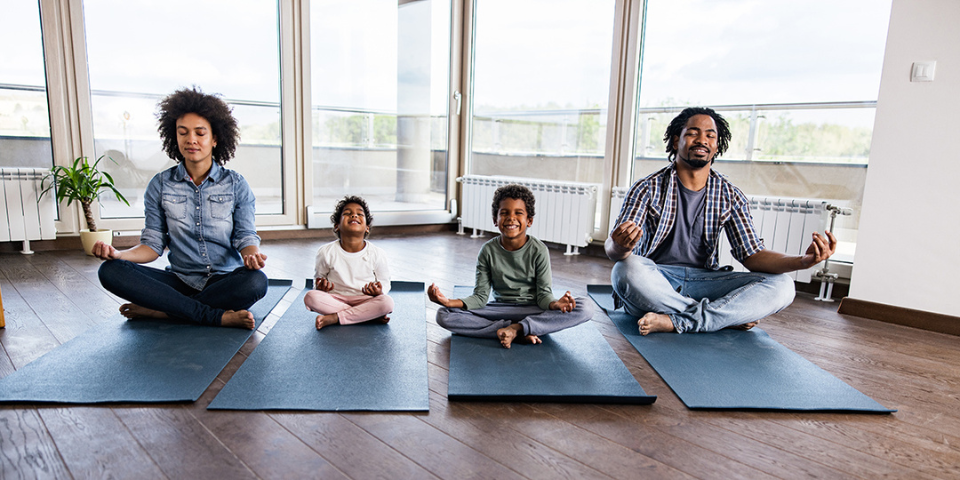
Engaging the whole family in yoga can be incredibly beneficial, according to NASM-certified trainer and E-RYT 500 yoga teacher Amber DiPietro. In today’s world, the advantages of yoga are plentiful for both kids and parents.
“Yoga offers a wide range of benefits whether practiced individually or as a family,” she explains. “It can reduce stress and anxiety, enhance focus and concentration, lower blood pressure, improve sleep, increase energy levels, and enhance muscle strength and flexibility.”
Benefits of Yoga for Kids

Studies have shown that yoga can boost self-esteem, memory, and mood in children and teenagers.
Benefits for kids
These benefits have been linked to improving their quality of life, overall wellbeing, and stress management. Research has also shown a consistent yoga practice to help alleviate symptoms of attention deficit disorder, such as inattentiveness and hyperactivity.
Benefits for teens
Teenagers can also experience these advantages. A study on yoga for high school students revealed that after a single class, participants exhibited reduced anger, depression symptoms, and fatigue.
Benefits for parents
For parents or caregivers, practicing yoga together provides an opportunity for quality bonding time, according to DiPietro. It allows everyone to connect and understand each other better.
“You get to witness how your child learns and perseveres, while your child sees the benefits of a healthy lifestyle,” she points out. “Simply engaging in breath exercises and finding harmony can strengthen your bond.”
The Best Yoga Poses for Kids
An excellent way to introduce yoga to the whole family is through a short Level 1 class on BODi’s Yoga52 program. These classes feature beginner-friendly poses, and you can select the duration that suits everyone’s schedule. Breaking a 30-minute session into two 15-minute parts allows for consistency and a shared yoga habit.
If you prefer to practice poses independently, here are some beginner-friendly options:
1. Child’s pose
- Begin on all fours, with hands under shoulders and knees hip-width apart or wider. Bring big toes together.
- Exhale and lower hips towards heels. Rest belly between thighs and forehead on the mat.
- Extend arms forward (palms down for a full back stretch) or along sides (palms up for shoulder stretch).
- Hold for a few breaths to a few minutes.
2. Cat-cow stretch
Inhale: Cow pose
- Get on all fours, with knees under hips and hands under shoulders. Keep back flat, gaze down, and neck long.
- Inhale and arch back, lifting tailbone and chest while dropping belly towards the mat.
- Keep shoulders away from ears, shoulder blades wide, and head aligned with torso.
Exhale: Cat pose
- From cow pose, exhale and round back, tuck tailbone, and bring chin to chest.
- Keep shoulders and knees stable.
- Inhale back to cow pose.
- Repeat for up to 10 breaths or longer.
3. Downward-facing dog

- Start on all fours, with knees under hips and wrists a few inches forward of shoulders. Point fingertips forward and spread fingers wide.
- Exhale, tuck toes, press into hands, straighten arms and legs, and lift hips towards the ceiling. Keep hands shoulder-width apart and feet hip-width apart.
- Rotate shoulders outward to avoid hunching. Keep arms straight, engage biceps, and look back at toes with ears in line with arms.
- Hold for one minute.
Progressing in Your Family Practice
As you become more comfortable with yoga, whether practicing as a family or with older children or teenagers exploring solo sessions, you may want to incorporate more poses.
“When you’re ready for a challenge, consider trying higher-level Yoga52 classes,” suggests Yoga52 trainer Brent Laffoon. “Even if not every pose or sequence is attainable, it’s fun to experiment with different options.”
Additionally, you can modify poses and even create your own variations based on fundamental yoga poses. Being innovative as a family adds to the joy of practicing yoga with kids.
“Expand your horizons,” encourages Laffoon.
Can you please rewrite the sentence for me?