

Reviewed by Denise Asafu-Adjei, M.D., MPH
A few years back, PN co-founder John Berardi, PhD, posted a shirtless photo of himself on his 47th birthday.
He called it his “anti-regress pic” and thanked 30 years of squats, deadlifts, presses, and chin-ups—among other exercises—for his chiseled six-pack, pumped chest, and bulging biceps.
The question many commenters posed:
“Are you on testosterone?”
Dr. Berardi explained in a follow-up post that while he wasn’t against testosterone replacement therapy (TRT) for people who needed it, he himself was not on this therapy, and his testosterone levels were boringly “normal.” He also offered some thought-provoking ideas about testosterone and aging.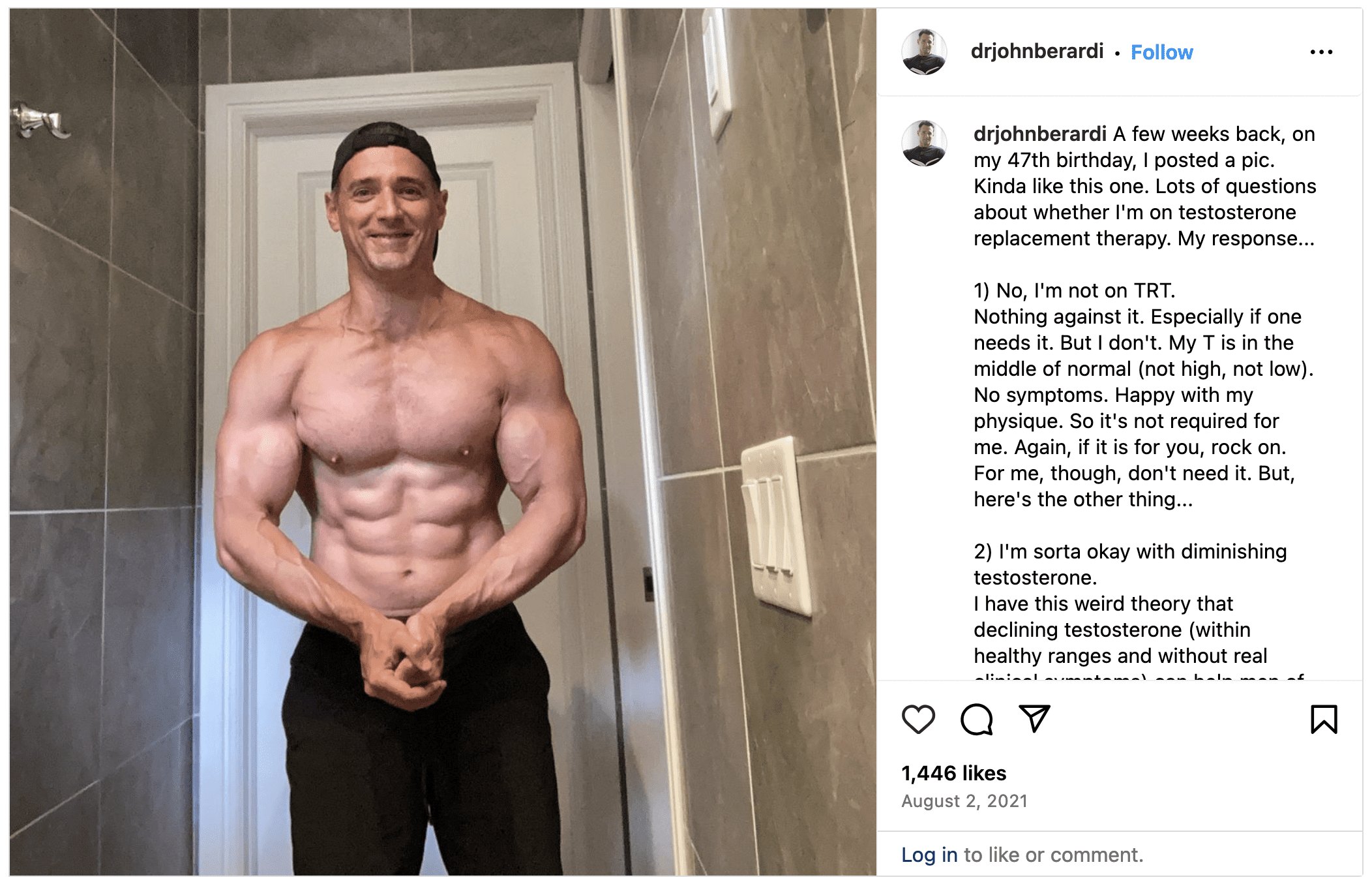 Dr. Berardi’s take is the opposite of what you generally hear, especially these days when…
- The mainstream opinion seems to be that declining testosterone is a harbinger of aging, frailty, and impotence—not to mention a threat to masculinity.
- Increasing numbers of middle-aged men are ditching traditional medical checkups for men’s-focused telehealth clinics that specialize in testosterone enhancement.1
- Reddit communities have popped up solely to obsess over neuroscientist Andrew Huberman’s supplement recommendations for optimizing testosterone.
- Media outlets pump out story after story about “testosterone boosting” foods to eat and “testosterone lowering” foods to avoid.
Whether you’re a coach who fields the “How do I optimize testosterone?” question from clients—or just a regular dude hoping to age well—it’s easy to feel overwhelmed and confused by the conflicting information.
Are declining testosterone levels normal?
Do testosterone-boosting supplement regimens actually work?
Who benefits from testosterone therapy—and who doesn’t?
In this story, we’ll explore those questions and more.
What is testosterone?
Secreted by the testes, testosterone is the sex hormone responsible for male sexual characteristics such as big muscles, deep voices, and hairy chests. It’s a chemical messenger that plays a key role in various processes throughout the body, including sperm production and bone density.
(In women, who also need testosterone to keep various processes humming, testosterone is secreted by the ovaries and adrenal glands. Their bodies just make much less of it; about 10 to 20 times less than men.)
Possibly because of its relationship with muscle growth and sex drive, a lot of cisgender men think of testosterone in binary terms, with lower testosterone being bad and higher testosterone being good.
However, it’s more accurate to think of the relationship between testosterone and health as a continuum that goes from too low (problematic) to too high (also problematic), with the healthy range falling between the two extremes, says Denise Asafu-Adjei, MD, MPH, urologist, men’s health expert, and assistant professor of urology at Loyola University Chicago-Stritch School of Medicine.
As the chart below shows, the dangers of extremely low testosterone are similar to the risks of extremely high amounts (typically only achievable with the use of anabolic steroids).
| Problems associated with extremely LOW testosterone | Problems associated with extremely HIGH testosterone |
|---|---|
|
|
Low testosterone vs. lower testosterone
Testosterone levels naturally ebb with age, with most men losing about 1 to 2 percent annually starting around age 40. By age 75, most men have 30 percent less of the hormone than they did at age 25.2
(Fun fact: Between ages 25 and 80, men can expect their testicles to shrink 15 percent.3)
However, age-related drops in testosterone are not the same thing as “low testosterone.”
Hypogonadism is the medical term for low testosterone levels, and it affects about 35 percent of men older than 45 and 30 to 50 percent of men who have obesity or type 2 diabetes, according to the Endocrine Society, one of the professional public health organizations that sets hypogonadism treatment guidelines.
Not only can overly low testosterone make you feel fatigued and do a serious number on your sex drive, but it can also harm your bone and cardiovascular health, says Dr. Asafu-Adjei.
“You need testosterone for good bone strength,” says Dr. Asafu-Adjei. “As you get older, you’re already dealing with weaker bones, so having lowered testosterone isn’t going to help.”
Alternatively, bringing levels up to normal seems to offer cardiovascular benefits, she says. (The big caveat here is up to normal—not far above it.)
The importance of referring out
What if you or your client have most of the hallmark symptoms of hypogonadism but still have blood levels of testosterone in the normal range?
“Many men over 30 who feel down or low energy will now automatically blame their testosterone,” says Dr. Asafu-Adjei.
Their symptoms may be linked to testosterone, but they could also be connected to factors such as lack of sleep, stress, or other issues. This is why consulting a healthcare professional specializing in men’s health and testosterone management is crucial. Such a physician can conduct a thorough screening for various problems and conditions that may mimic the symptoms of hypogonadism or affect testosterone production. It’s important to note that while supplemental testosterone may be the solution for some men with hypogonadism symptoms, it may not be suitable for everyone. A comprehensive evaluation is necessary.
Dr. Asafu-Adjei emphasizes the importance of looking beyond total testosterone levels and considering factors like the testosterone-to-estrogen ratio and other related hormones. Therefore, it is recommended to seek assistance from a knowledgeable professional who can conduct a detailed analysis to identify the root cause of the issue.
If you specialize in coaching middle-aged and older men, it is advised to have a urologist or endocrinologist in your referral network for further guidance and support.
If you’re interested in the connection between testosterone and aggression in humans, there are several studies worth exploring:
– A meta-analytic examination looked at the relationship between baseline, dynamic, and manipulated testosterone levels and human aggression (Horm Behav. 2020 Jul;123:104644).
– Another study found that testosterone can lead to both prosocial and antisocial behaviors in males, enhancing their social status (Proc Natl Acad Sci U S A. 2016 Oct 11;113(41):11633–8).
– The Male Warrior Hypothesis suggests that testosterone is linked to cooperation and aggression during intergroup conflict (Sci Rep. 2020 Jan 15;10(1):375).
– Sleep disorders have been associated with testosterone deficiency and erectile dysfunction in a U.S. claims database analysis (Int J Impot Res. 2022 Dec 6;36(1):78–82).
– Research has shown that both partial and total sleep deprivation can impact serum testosterone levels in healthy males (Sleep Med. 2021 Dec;88:267–73).
– Short-term sleep restriction has been found to lower testosterone levels in young healthy men (JAMA. 2011 Jun 1;305(21):2173–4).
– The link between estradiol, obesity, and hypogonadism has been explored in a study (Physiol Res. 2020 Sep 30;69(Suppl 2):S273–8).
– Adverse changes in testosterone levels in men can be influenced by various factors, as discussed in an expert review (Expert Rev Endocrinol Metab. 2020 Sep;15(5):355–62).
– Exercise may modulate the effect of testosterone levels in men, depending on different factors (J Funct Morphol Kinesiol. 2020 Nov 7;5(4)).
– Hypogonadism in exercising males is a topic of interest, with some considering it a dysfunction and others suggesting it as an adaptive-regulatory adjustment (Front Endocrinol. 2020 Jan 31;11:11).
– Dietary habits have also been linked to erectile dysfunction in men, with certain foods potentially affecting sexual health (JAMA Netw Open. 2020 Nov 2;3(11):e2021701).
– Stress-induced cortisol release has been shown to depress testosterone secretion in patients with type 2 diabetes mellitus (Clin Med Insights Endocrinol Diabetes. 2023 Jan 3;16:11795514221145841).
– Salivary testosterone levels under psychological stress have been studied in relation to rumination and personality traits in medical students (Psychiatry Investig. 2016 Nov;13(6):637–43).
– The correlation between serum zinc levels and testosterone has been explored in a systematic review, shedding light on the importance of this mineral (J Trace Elem Med Biol. 2023 Mar;76:127124).
– Dietary zinc depletion has been found to impact seminal volume, serum testosterone concentrations, and sperm morphology in young men (Am J Clin Nutr. 1992 Jul;56(1):148–57).
– Testosterone levels in men can decrease over time, as discussed in a study on the descent of testosterone in males (Proc Natl Acad Sci U S A. 2011 Sep 27;108(39):16141–2).
If you’re passionate about helping others improve their health through sustainable nutrition and lifestyle habits, consider becoming a certified nutrition coach with the PN Level 1 Nutrition Coaching Certification. This certification can empower you to make a positive impact on people’s physical and mental well-being while pursuing a fulfilling career. Please rewrite the following text so it is clear and concise:
“The company has decided to implement a new policy that requires all employees to fill out a form before requesting time off.”