
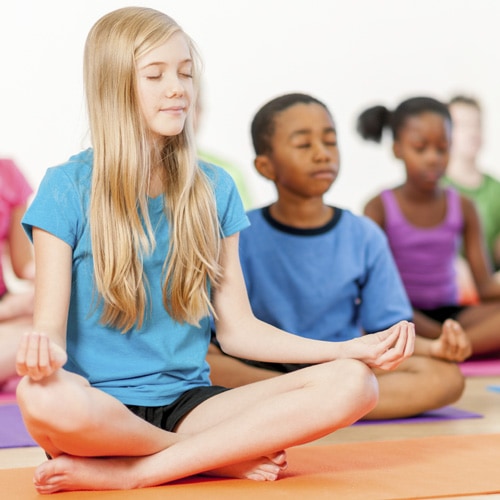
Do you know the different types of meditation for kids, their benefits, and how to teach them?
If not, this article is for you.
Childhood and teenage years are foundational in our development as human beings…
The skills and tools we learn in our early years have a huge impact on the rest of our lives—and that is why meditation is such a great gift to give to a child…
I started meditating when I was just 14—and this practice gave me many things in my life…
So on this page I explore why kids should do meditation, how to teach them, and the different types of meditation for kids…
“True education means providing an optimal environment in which each child’s self-regulated learning process can unfold naturally…
That is not only one man’s opinion. In fact, the American Academy of Pediatrics (AAP) encourages parents to share meditation with their children—and teachers to incorporate mindfulness training into their lesson plans…
The Benefits of Meditation for Kids
It’s the dream of many parents to be able to calm down their kids, teach them how to manage themselves, and see them grow into happy, healthy and fulfilled individuals…
Kids face many challenges, such as:
- An influx of energy that can be overwhelming
- Pressure from school and peers
- Performance demands in studies and sport
- Difficulty focusing
- Difficulty building healthy relationships with others
- Bullying
- Competition
- Low self-esteem
- Managing their own emotions—such as anger, disappointment, anxiety
In our modern society these problems are aggravated by social media…
As a result, mental health issues in kids—such as anxiety and depression—are increasing…
So it seems that kids have the cards stacked against them. In this context, it is our responsibility as parents and educators—and as a society—to teach our young generation tools that can make a real difference…
That is where meditation, which is a practice of relaxation, awareness, focus and stillness (definition), comes into play…
Thankfully, we are seeing a movement to integrate meditation and mindfulness in education…
Here are a few positive results:
- Better behavior. A school in Baltimore replaced detention with meditation class for kids, and had no suspensions throughout the entire year, after the meditation room was installed…
- Less ADHD. A Midwest elementary school conducted an 8-week mindfulness program with 3rd-grade students, after which teachers reported less inattentiveness, less hyperactivity, and fewer symptoms of ADHD…
- Students are more focused and settled, calm and rested, according to a Swinburn University study…
- Better school performance. San Francisco schools offering meditation programs reported satisfactory English scores on the standardized California Achievement Test at a rate twice that of non-meditation schools…
- Less stress and depression. At Burton High School in San Francisco, students who participated in a meditation program reported significantly less stress and depression than other students…
- Improved psychological well-being. Kids who practice mindfulness will experience fewer psychological complexes such as feafulness, social withdrawal and anxiety…
For more information on the benefits of meditation for kids, you can visit this [source](https://mindfulnessinschools.org/research/).
Research has shown that meditation can have numerous positive effects on children, such as improving their relationship with their parents, enhancing impulse control, boosting self-esteem, increasing empathy and social skills, reducing test anxiety, and alleviating post-traumatic symptoms. It is believed that many other benefits of meditation would also be applicable to children.
The Dalai Lama once said, “If every 8-year-old in the world is taught meditation, we will eliminate violence from the world within one generation.” This highlights the potential impact of meditation on children’s well-being.
Through meditation, kids can learn to better manage their bodies, energy, and emotions. It can lead to an increase in emotional intelligence, a more positive outlook on life, and improved self-regulation. Additionally, children can develop better organization skills, learn to be more present and less judgmental, and respond rather than react to life events. Overall, meditation can help children feel better, learn better, and sleep better.
The skills acquired through meditation will benefit children in various aspects of their lives, extending into their teenage years and adulthood. It becomes an integral part of their development and equips them with resources to navigate the world, setting them up for a happier and healthier life.
When teaching meditation to children, it is important to consider their unique characteristics. Children have less patience, shorter attention spans, and a greater capacity for imagination and playfulness. Therefore, it is essential to make meditation engaging and fun for them.
To effectively teach meditation to kids, six principles should be kept in mind. These include making the practice engaging and fun, appealing to their imagination, keeping sessions short, leading by example, and adapting techniques based on the child’s age and personality. By incorporating these principles, children can benefit from the practice of meditation and develop valuable skills that will positively impact their lives. Do you want your children to have a regular and disciplined meditation practice? It’s important for you to also be disciplined and make meditation a family practice. (If you need help establishing your own meditation routine, consider my Master Your Mind meditation course for beginners.)
At the end of your meditation session with your children, ask them about their experience. Encourage them to draw what they felt during the session, or a “before and after” drawing. This can help children develop self-awareness and self-expression.
When children share their experiences, validate them. Accept everything they say, even if it seems exaggerated, as it allows room for their imagination to grow. If you are leading a group of children, make sure to affirm everyone’s experiences, ensuring no child is confused, lost, or unhappy.
Lastly, manage your expectations. Meditation is a process that takes time. It won’t turn your child into a “junior-Buddha” overnight, but it will provide them with valuable tools to understand themselves better, manage their emotions, and cultivate inner calm and strength. Then, shut your eyes and repeat the procedure. To learn more about guiding meditation for children, including scripts, refer to the chapter “Meditation for Children” in the book “Sure Ways to Self-Realization.” The book can be found here.
10. Humming Bee Breathing
The tradition of Yoga offers various breathing exercises, known as pranayama. One simple exercise that children may find interesting is the Humming Bee Breathing technique:
- Close your mouth with your teeth apart.
- Close both ears with your thumbs or index fingers, keeping elbows raised horizontally.
- Inhale slowly through your nose.
- Exhale slowly while making a continuous humming sound, “huuuuuuummmmmmm”. Feel the vibrations throughout your head and chest.
- Practice for about 5 minutes.
- Close your mouth, breathe normally, and observe your natural breath flow.
- Notice the calming and relaxing effects on your body and mind.
Benefits: This practice promotes calmness and relaxation in children, regardless of their ability to focus.
11. Mindfulness Meditation for Kids: Observing Thoughts and Feelings (Mind)
The following practices are more suitable for older children, requiring some mental development:
- Begin with mindfulness of breath practice for a few minutes.
- Observe your mind, noticing thoughts, feelings, words, and images that arise.
- Watch thoughts and feelings come and go like clouds in the sky, unaffected by them.
- You can label thoughts as they arise, without judgment or attachment.
- Simply observe thoughts and emotions without reacting or analyzing them.
This practice enhances self-awareness and emotional regulation in children, fostering emotional intelligence and well-being.
12. Loving Kindness for Kids (Heart)
Variation 1: Self-Love
- Sit for meditation, close your eyes.
- Recall a time when you felt deeply loved and cared for.
- Place your hands on your chest, feeling that warmth.
- Repeat the affirmation “May I be happy. May I be safe. May I be at peace.” while connecting with that feeling.
Variation 2: Healing Conflicts
- Sit for meditation, close your eyes.
- Think of a person you have a conflict with.
- Put yourself in their shoes, understanding their perspective.
- Send loving-kindness to that person, wishing them happiness, safety, and peace.
Benefits: These meditations cultivate positive emotions, empathy, and compassion, fostering social connections and emotional well-being.
In conclusion, teaching meditation to children can help them manage themselves and develop into kind, capable individuals. This practice can give them an advantage in adulthood. This article aimed to highlight the benefits of meditation for kids and introduce various meditation techniques suitable for children and teenagers. Can you rewrite the following sentence? Can you rewrite the following sentence for me?