
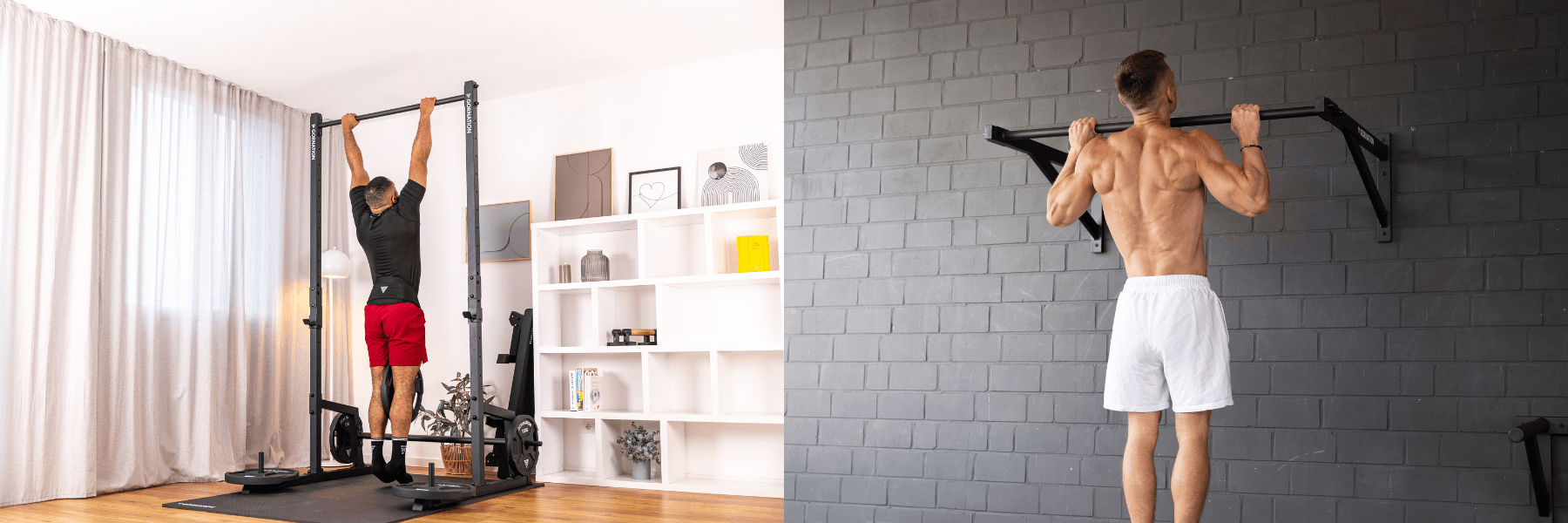
Pull-ups are one of those exercises that never lose their relevance. Simple, effective, and challenging at every level. But before you even start training, there’s one important question: which pull-up bar actually fits your space and your training style? Not everyone wants to drill into their walls, while others are looking for the most stable setup possible. Free-standing and wall-mounted pull-up bars solve different problems, and choosing the right one can make your workouts a lot more enjoyable. In this guide, we’ll take a closer look at both options and help you decide which pull-up bar works best for your home training.
Advantages of a Free-Standing Pull-Up Bar
The Free-Standing Pull-Up Bar is a versatile and mobile solution, perfect if you don’t want to drill into your wall. It’s a self-supporting station that can be easily set up in any room, garage, or even outdoors.
Key Benefits:
-
No installation required: set it up, train, and store it away easily.
-
Mobility: perfect for athletes who train in different spaces.
-
Versatility: often part of a complete pull-up station, allowing you to perform not only pull-ups, but also dips, push-ups and other exercises.
-
Stability: high-quality models like those from GORNATION offer great stability, even for dynamic movements.
Discover our Free-Standing Pull-Up Bar designed for powerful and varied workouts, both indoors and outdoors.

Advantages of a Wall-Mounted Pull-Up Bar
The wall-mounted pull-up bar is ideal if you’re looking for a fixed and ultra-stable setup. It’s the preferred choice for calisthenics and strength training enthusiasts who want maximum stability and minimal space usage.
Key Benefits:
-
Superior strength: once installed, it can support heavy loads and explosive exercises like muscle-ups.
-
Space-saving design: takes up no floor space – perfect for small home gyms or apartments.
-
Optimal alignment: a well-installed wall bar gives you a stable position for strict pull-ups without movement.
Check out the Wall-Mounted Pull Up Bar, robust, sleek, and suitable for all levels.

Free-Standing vs Wall-Mounted Pull-Up Bar: The Comparison
| Feature | Free-Standing Pull-Up Bar | Wall-Mounted Pull-Up Bar |
|---|---|---|
| Installation | No drilling, ready to use | Requires drilling and secure mounting |
| Mobility | Easy to move | Fixed in place |
| Stability | Stable depending on model | Excellent stability (depends on wall) |
| Space | Requires floor space | No floor space needed |
| Versatility | Multiple exercises possible | Perfect for pull-ups and variations |
| Skill Level | Beginner to advanced | Intermediate to expert |
| Usage | Indoor & outdoor | Indoor (or solid outdoor wall) |
| Maintenance | Easy to clean | Regular check of fixings recommended |
Which Pull-Up Bar Should You Choose?
Your choice depends on your training space, experience, and workout style.
-
Small apartment or solid wall? Choose the wall-mounted pull-up bar – it saves floor space and offers a rock-solid feel.
-
Can’t drill your walls? (renter or fragile walls) Go for a free-standing pull-up bar – easy to move and store.
-
Want more exercise options? Free-standing pull-up stations let you do dips, push-ups and other exercises in one setup.
-
Training for muscle-ups or weighted pull-ups? Choose the wall-mounted bar for better power and control.
Want to See the Difference in Action?
If you’re unsure which pull-up bar fits your setup best, check out our YouTube video where we compare free-standing and wall-mounted pull-up bars side by side.
or product names.
In the realm of health and wellness, it’s essential to understand the distinctions between various workout equipment options. By exploring real-life training scenarios, we can determine which choice is best suited for different environments and fitness objectives.
When it comes to a free-standing pull-up bar, it offers versatility but comes with limitations. Full muscle-ups can be challenging due to the restricted height and lack of momentum. Additionally, explosive movements like kipping pull-ups may lead to instability. The bar also takes up more floor space, which can be problematic in smaller areas.
On the other hand, a wall-mounted pull-up bar, while sturdy, has its drawbacks as well. Once installed, it cannot be moved. It also doesn’t allow for dips or push-ups like a full station would. Furthermore, a strong wall (made of concrete or brick) is necessary for safety and stability.
When considering a free-standing pull-up bar from GORNATION, you’re investing in a product designed for stability, performance, and freedom of movement. The reinforced steel construction ensures maximum durability, while the ergonomic design enhances comfort during pull-ups. This bar is also compatible with calisthenics accessories like resistance bands, rings, and dip belts, making it ideal for flexible home gyms or outdoor workouts.
Conversely, opting for a wall-mounted pull-up bar from GORNATION is a choice for athletes seeking quality and performance. Made of ultra-strong steel to support heavy loads, this bar features non-slip grips for a secure hold and a compact, modern design perfect for small spaces. It’s well-suited for strict pull-ups, muscle-ups, and core exercises.
In conclusion, both the free-standing and wall-mounted pull-up bars cater to different needs. If you prioritize freedom and versatility, the free-standing model is the way to go. However, if stability and power are your main concerns, the wall-mounted version is the better option. Whatever your choice, GORNATION offers professional-grade equipment to help you surpass your limits and enhance your training routine. Can you please rewrite the following sentence?