
If you’ve heard of billionaire Bryan Johnson, you’ve likely encountered the phrase “bio age testing.”
Johnson, the subject of the Netflix documentary Don’t Die, says he’s on a quest to achieve the lowest possible “biological age” (also known as bio age).
He reportedly spends millions each year on anti-aging treatments—dozens of daily supplements, weekly acid peels for his skin, injections to boost collagen production, hyperbaric oxygen therapy, and plasma infusions extracted from his 17-year-old son’s body.
To determine what’s working, Johnson has undergone numerous tests to assess his bio age. Johnson says these tests show his age is now 5.1 years younger than when he embarked on his anti-aging quest.
Apparently, he’s aging in reverse.
Granted, not everyone’s buying it. A New York Times exposé, for example, claims Johnson’s biological age, in reality, has increased by 10 years.1
Still, Johnson’s “don’t die” crusade is gaining traction.
Bio age tests are a frequent topic on popular podcasts by Peter Attia, Joe Rogan, and Andrew Huberman. Google “bio age testing” and you’ll see dozens of ads for mail-order blood or urine testing kits that claim to reveal your biological age, pace of aging, and more. With prices tumbling into affordability, it’s natural to wonder…
Should you or your client sign up for bio age testing?
If so, which test is best? Just as importantly, what should you do with the information?
In this story, you’ll learn:
What is your bio age?
Your biological age (bio age) refers to how your cells function. It’s not necessarily the same as your chronological age, which refers to the number of candles on your birthday cake.
For example, let’s say Chang, a 50-year-old man, works at a desk, spends his free time in front of the TV, lives in the most polluted city in the world, eats a candy bar for lunch, and smokes. On the other hand, Jabari, a different 50-year-old man, hits the gym several times a week, lives in the mountains, doesn’t smoke, relishes his five servings of veggies a day, meditates, and spends most evenings in his garden.
Genetics aside, you’d be wise to wager that Jabari’s bio age is younger than Chang’s.
How do these tests measure bio age?
Bio age testing kits measure one or more biological markers of aging, also known as biomarkers.
For example, some tests focus on the size of your telomeres, the protective caps at the ends of chromosomes. Others measure DNA methylation, a physiological process that chemically alters DNA.
Once a company isolates and measures these markers from your blood or urine, it plugs the bio data into a formula that calculates your bio age.
However, if you see a doctor with any regularity, you’re likely already tracking some biomarkers of aging. For example, biomarkers such as blood pressure, cholesterol levels, and blood glucose can help predict your risk of future cardiovascular disease, a leading cause of premature death.
What’s the point of biomarker testing?
Biomarker testing can help you monitor your wellness proactively rather than waiting for disease symptoms to appear.
For some, it also serves as a motivator. If you learn you have the bones of someone 20 years older, this may give you the nudge you need to start strength training consistently.
In addition, biomarkers provide objective data, allowing you to track and evaluate various health-related actions quantitatively. By monitoring your blood pressure, you might learn that consistent exercise helps, but your late-afternoon energy drink does the opposite.
5 FREE biomarker tests
You don’t have to be a billionaire (or even a millionaire) to track biomarkers of aging.
In this section, we’ll cover several massively underappreciated, scientifically validated tests you can use to gain insight into your bio age—for FREE.
Before scientists developed high-tech blood-based bio age tests, researchers used these free tests to calculate the pace of aging in the people they studied.
FREE biomarker test #1: Get off the floor
People who are fitter and stronger tend to live longer.2
That’s because muscles do more than just move us around. They also secrete anti-inflammatory substances, help to regulate blood sugar, slow cellular aging, protect the lining of the arteries, and more. All this helps reduce the risk of age-related diseases, such as type 2 diabetes, high blood pressure, and heart disease, a phenomenon we explore in our article, The New Science of Muscle.
Related to strength, your ability to balance is also key. If you’re middle-aged or older and can’t stand on one foot for at least 10 seconds, your risk of dying in the next seven years is double that of someone who can stand for longer, according to a study of 1,700 people.3
The Sitting-Rising Test (SRT) is one way to assess both strength and balance at the same time.
People with low scores on this test have a higher risk of dying from cardiovascular disease, according to a 12-year study of 4,200 adults between the ages of 46 and 75.4
▶ How to measure it
Lower yourself to the floor with your legs in a crisscross position. Then, with your legs in the same position, stand back up. As you stand, notice if you must use a part of your body—hand, shin, knee—as leverage.
To score yourself, start with 10 points. Then, for each body part you used to stand, deduct a point. Subtract a half point if you became unsteady or lost your balance.
Keep in mind that this (and other tests) serve as a proxy for your fitness. A low score indicates that your balance and coordination, muscle strength and power, and mobility may all require some attention.
FREE biomarker test #2: Squeeze a ball
Like the SRT test, your grip strength provides insight into your overall fitness. If the muscles in your hands are weak, the muscles throughout your body are more likely to be weak, too.
Poor grip strength can also predict future muscle weakness. One study found that individuals with weak grip strength were more likely to walk slowly and have difficulty with tasks such as rising from a chair, completing housework, and climbing stairs 25 years later. Low grip strength has also been linked to low bone mineral density, increased risk of falls, poor nutritional status, depression, poor sleep, cognitive function, decreased quality of life, and increased risk of heart disease, cancer, and premature mortality. Grip strength has been suggested to be a better indicator of longevity than blood pressure. To measure grip strength, squeeze a standard tennis ball as hard as you can for as long as possible. Stand on one foot for an extended period to test balance, which can help reduce the risk of falls and indicate overall health and fitness. Fatigue can be an early sign of underlying health issues, and fatiguability, or how worn out one feels after an activity, can predict longevity. To measure fatigability, use the Pittsburgh Fatigability Scale. Body composition, particularly the balance between body fat and muscle mass, is important for health. Use a tape measure to track body fat percentage by measuring the widest part of your neck, the narrowest part of your waist, and the widest part of your hips. Doctor-approved tests, such as a blood panel, can provide valuable information about overall health and the risk of conditions like type 2 diabetes and heart disease. This makes them useful tools for tracking the effectiveness of lifestyle or medical changes.
▶ How to assess it
If you haven’t already, consider getting annual tests for the following blood markers. Discuss the results with your healthcare provider to understand their significance. These numbers, along with your blood pressure, may be used to calculate your risk of cardiovascular disease.
These $100 tests can satisfy your curiosity, but should not be the sole basis for making health and fitness decisions.
Commercial test #3: VO2 Max
In the past, only elite athletes were concerned with VO2 max, which measures the maximum amount of oxygen your body can utilize during exercise. However, some experts now suggest that monitoring VO2 max can provide valuable insights for athletes and non-athletes alike, indicating the rate at which their bodies are aging.
Individuals with high VO2 max levels are not only typically more physically fit, but also less likely to develop heart disease, diabetes, cancer, or stroke. A study tracking the health outcomes of 5,107 Danish men over 46 years found that those with above-average VO2 max during middle age lived an average of five years longer than those with below-average levels. Each unit increase in VO2 max was associated with a 45-day increase in longevity, leading researchers to believe that VO2 max may be a more accurate predictor of all-cause mortality than factors like high cholesterol, obesity, high blood pressure, and insulin resistance.
As we age, various physiological changes occur in our bodies that can impact VO2 max. These changes can increase the risk of developing various diseases, while also contributing to the decline in VO2 max, which typically decreases by 10 percent per decade starting around age 30.
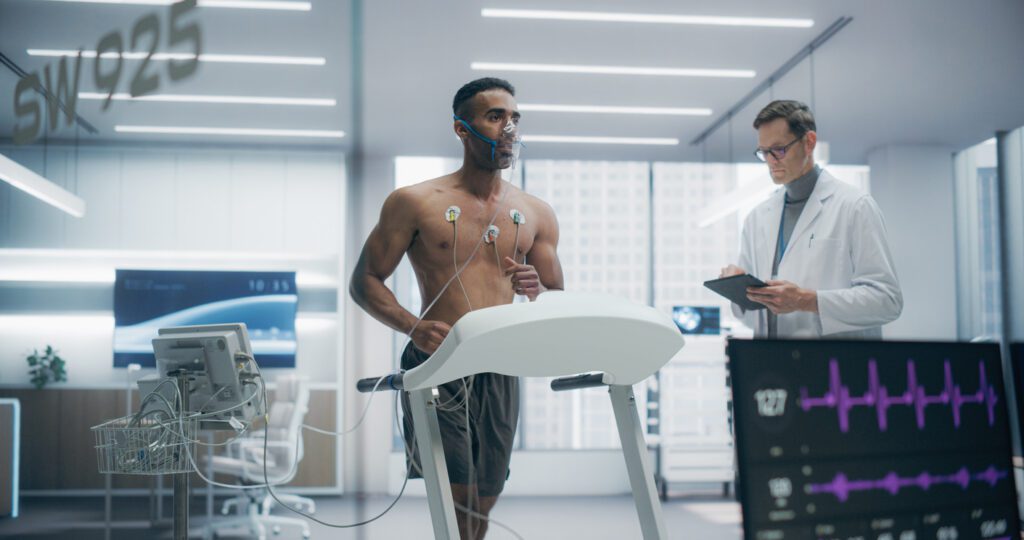
Traditionally, the most reliable method for measuring VO2 max was in a fitness lab, where individuals would undergo testing wearing a metabolic mask and heart monitor while performing strenuous exercise. This lab-based testing remains the most accurate way to measure VO2 max and other important fitness metrics, such as max heart rate, ventilatory thresholds, and tidal volume.
While in-office VO2 max testing can cost around $150, there are alternative, less accurate methods available for those without access to a specialized clinic. These include the 1-mile walk test, using a smartwatch, or conducting a PR test like the Cooper test.
Remember, the information you gather about your body is just that—information. It’s not a judgment of who you are as a person, nor is it a permanent situation. With the right lifestyle changes, you have the power to improve your health and fitness, regardless of your current biological age. When it comes to lifestyle changes related to longevity, however, most people tend to make two major mistakes.
The first mistake involves ignoring evergreen, big-impact strategies that may seem simple or boring, but when consistently practiced, can lead to a long and healthy life. These strategies include consuming minimally processed foods, eating more fruits and veggies, regular physical activity, sufficient rest and sleep, engaging in meaningful activities, moderating alcohol intake, avoiding tobacco, wearing sunscreen, and flossing, among others. Research shows that people who follow these high-impact strategies not only live longer but also live better, with improved strength, happiness, and reduced disability or pain in later years.
The second mistake is not translating data into action. While biomarker aging tests can provide valuable information, simply gathering data without making any changes in behavior is ineffective. It’s like seeing spinach stuck in your teeth in the mirror but not doing anything about it. Biomarker data should be used as a baseline to assess whether lifestyle changes or medical interventions are helping you progress towards your goal of a longer and healthier life.
In conclusion, it’s essential to prioritize impactful strategies and to use data to inform behavioral changes in order to make meaningful progress towards longevity and overall well-being. If you’re in the health and fitness field, you understand the struggle your clients face when stressed and fatigued. Simple tasks like hitting the gym, making healthy food choices, and resisting cravings can feel like monumental challenges.
But with the right strategies, you can help your clients navigate through chronic stress and sleep issues to achieve the lasting health transformations they desire.
Obtaining PN’s Level 1 Sleep, Stress Management, and Recovery (SSR) Coaching Certification equips you with the necessary tools to support your clients effectively. This certification not only boosts your confidence but also establishes you as a specialized coach capable of overcoming the biggest obstacles hindering your clients’ progress. Join the SSR Early Access List today for exclusive perks and the best discounts available. Please rewrite the following sentence for me. Please rewrite the following text.