
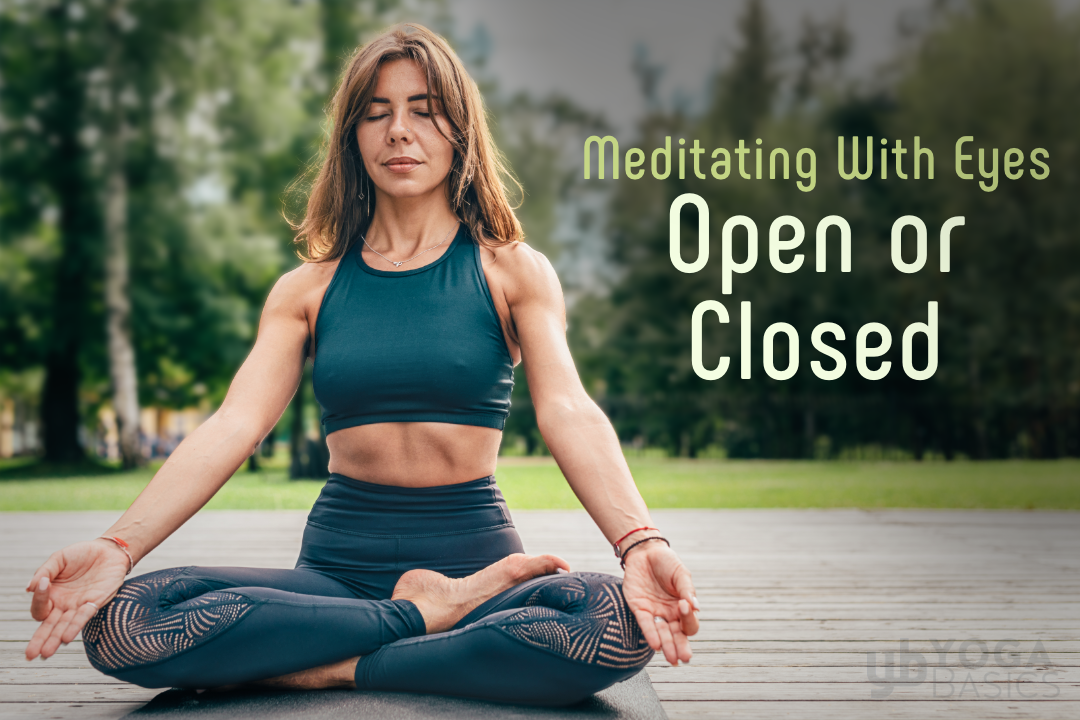
When starting meditation, there are many things to consider: which technique to try, how long to sit, and how to breathe. One important question that often gets overlooked is whether to meditate with your eyes open or closed. Both methods have their own advantages and disadvantages, and the way you use your eyes can greatly impact your meditation practice. Understanding the benefits and challenges of each approach can help you decide based on your unique needs, experience, and goals.
The Role of Eyes in Meditation
Where you direct your gaze during meditation can affect your mental focus, awareness, and emotional regulation. Closing your eyes can reduce external distractions, allowing for deeper internal awareness. On the other hand, keeping your eyes open can provide a focal point for concentration, known as dharana. For beginners, I generally recommend starting with eyes closed.
The Power of Drishti
Ancient yogis discovered that our attention follows our gaze. They introduced the concept of drishti, using specific focal points to maintain a focused mind during meditation. While drishti is often used in open-eye meditation, internal focus points can also be utilized with eyes closed. Drishti serves as a tool to keep the mind focused on one spot, aiding in concentration.
The Spiritual Eye
In the yogic tradition, there is a significant internal focal point known as the spiritual eye, located between the eyebrows. Also referred to as the third eye or Ajna chakra, it is believed to offer deeper insight and awareness. By shifting your attention to this point, you can move away from the distractions of the ego mind, elevating consciousness and enhancing spiritual awareness.
Vyutthana and Nirodha
In yogic philosophy, two concepts describe the movement of awareness in the mind: vyutthana and nirodha. Vyutthana represents the outward force that pulls the mind towards distractions, while nirodha is the inward force that leads to calmness and clarity. During meditation, the mind often experiences vyutthana, where thoughts pull attention outward. Closing the eyes can help reduce this outward force, making it easier to maintain internal focus.
Advantages and Disadvantages of Meditating with Eyes Closed
- Reduces external distractions: Closing your eyes eliminates visual stimuli, allowing for better focus.
- Deepens internal focus: Fewer distractions promote enhanced concentration.
- Enhances visualization and internal awareness: Eyes-closed meditation aids in visualizing and connecting with bodily sensations.
- Promotes relaxation: Shutting out external stimuli can induce a peaceful state and reduce stress.
Advantages and Disadvantages of Meditating with Eyes Open
- Enhances alertness: Keeping your eyes open helps you stay awake and attentive during meditation.
- Useful for mindfulness in daily life: Practicing open-eye meditation can improve focus in everyday activities.
- Reduces drowsiness: Light stimulation from open eyes can help prevent sleepiness.
When deciding whether to meditate with eyes open or closed, consider factors such as your environment, experience level, and meditation goals. Experiment with both approaches to see which resonates best with you. You can also combine them in a single session to explore different levels of focus and awareness.
Meditation Techniques by Eye Position, Pros, and Cons
| Meditation Technique | Eye Position | Description | Benefits | Challenges |
|---|---|---|---|---|
| Guided Meditation | Closed | Listening to a teacher’s guidance. | Keeps the mind engaged. | May require external audio. |
| Body Scan Meditation | Closed | Focuses on physical sensations. | Anchors attention to the present moment. | Emotional challenges may arise. |
| Visualization Practices | Closed | Imagining calming scenes or positive images. | Enhances internal awareness and creativity. | Requires focus and imagination. |
| Breath Awareness | Open or Closed | Focusing on breath sensations. | Promotes relaxation and calmness. | May lead to wandering thoughts. |
| Blindfold Meditation | Closed | Using a light barrier for reduced distractions. | Prevents drowsiness while meditating. | May be uncomfortable. |
| Soft, Unfocused Gaze | Open | Gazing gently without sharp focus. | Maintains alertness with minimal distraction. | Requires practice to avoid focusing too much. |
| Gazing at a Fixed Point (Trataka) | Open | Concentrating on a single point for intense focus. | Builds concentration. | Possible eye strain. |
| Mindful Observation | Open | Observing surroundings without judgment. | Enhances present-moment awareness. | External distractions may disrupt focus. |
| Zazen (Zen Meditation) | Open | Staring at a blank wall to cultivate calm alertness. | Develops detachment and focus. | Requires discipline. |
| Walking Meditation | Open | Moving mindfully while paying attention to each step. | Integrates mindfulness with movement. | Challenges focus in busy areas. |
It’s essential to explore different meditation techniques and eye positions to find what works best for you. Whether you prefer eyes open or closed, the key is to approach your practice with curiosity, self-compassion, and a sense of adventure. Listen to your inner guidance and allow your meditation journey to unfold naturally.